Serving & Batching
CKE is a C-first compiler, kernel library and runtime; serving is a layer on top of the generated model, not a redefinition of the project. This page documents how HTTP serving actually executes today, what the merged two-slot batch decode does and does not do, and what true continuous batching still requires.
Terms that must not be conflated
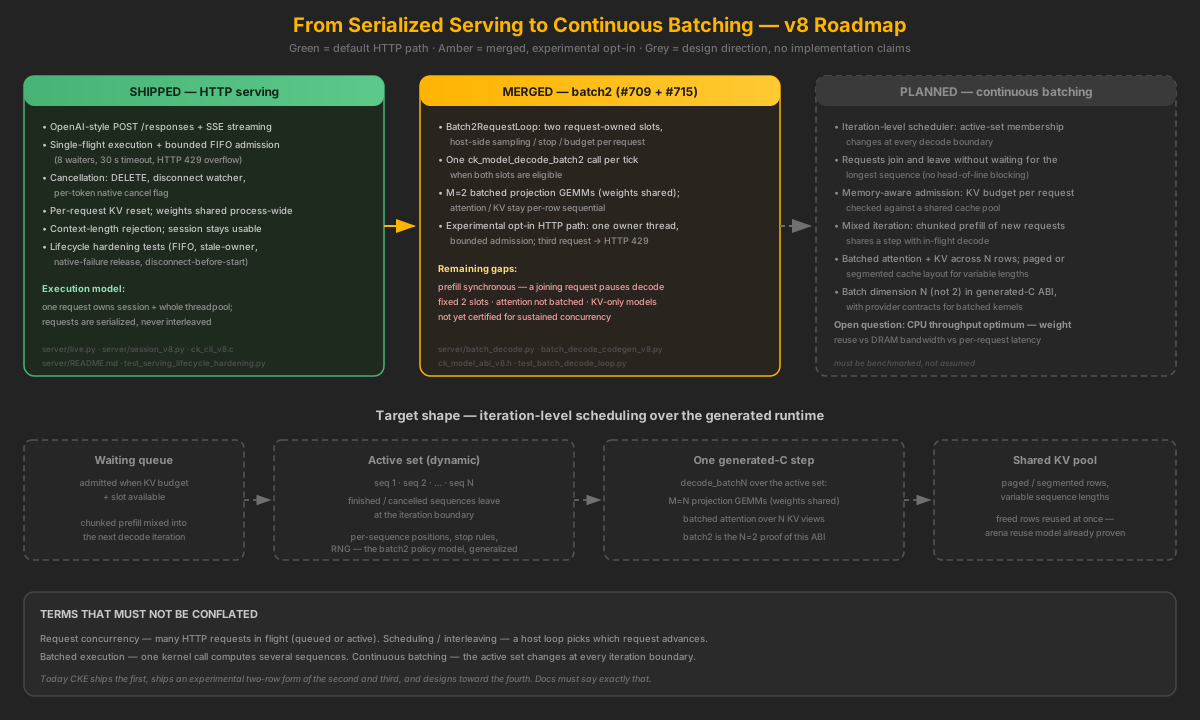
Four related but distinct capabilities. Claims about CKE serving should name exactly which one is meant:
- Request concurrency — many HTTP requests in flight (queued or active).
- Scheduling / interleaving — a host loop picks which request advances at each step.
- Batched execution — one kernel call computes several sequences in the same pass.
- Continuous batching — the active set changes at every iteration boundary: requests join and leave without waiting for the longest sequence.
Today CKE ships the first, ships an experimental two-row form of the second and third, and designs toward the fourth. Concurrent HTTP requests, multi-threaded kernels and serial request multiplexing are not, by themselves, batched decode.
Capability status
| Capability | Status | Source evidence | Test evidence |
|---|---|---|---|
HTTP serving (OpenAI-style /responses, SSE streaming) |
Shipped | server/live.py, version/v8/scripts/ck_serve_v8.py |
test_live_streaming.py, lifecycle hardening tests |
| Bounded admission (single-flight + FIFO queue, HTTP 429 overflow) | Shipped | server/live.py _FlightAdmission (8 waiters, 30 s) |
test_serving_lifecycle_hardening.py |
| Cancellation & cleanup (DELETE, disconnect watcher, per-token cancel) | Shipped | server/live.py, ck_cli_v8.c cancel flag |
lifecycle hardening + streaming socket tests |
| Per-request KV isolation in default mode (reset per request, shared weights) | Shipped | ck_session_v8_generate → kv_reset; one process-wide libmodel.so |
serving lifecycle tests; A→B→A smoke runs |
Two-slot batched decode (ck_model_decode_batch2, M=2 projection GEMMs) |
Experimental | server/batch_decode.py, batch_decode_codegen_v8.py, ck_model_abi_v8.h |
test_batch_decode_loop.py, test_v8_two_row_batch_decode.py |
Two-slot HTTP decode (opt-in --batch-http-extra-bytes) |
Experimental | server/batch_http.py, ck_serve_v8.py |
test_batch_http.py (19 tests, incl. real-socket SSE) |
| Iteration-level continuous batching (dynamic join/leave, N>2) | Planned | — | — |
| Mixed / interruptible prefill inside a decode step | Planned | — | — |
| Batched attention / KV across rows | Planned | — | — |
| Continuous-batching performance benchmarks | Planned | — | — |
Passing scheduler unit tests are not proof of batched model execution or end-to-end serving throughput; those require separate evidence. This table is the claim boundary for the whole page.
Who owns what — where scheduling ends and generated C begins
| Component | Owns |
|---|---|
| Model compiler + code generation | Circuit lowering, provider resolution, memory plan, emitted C |
Generated model runtime (libmodel.so) | Actual model execution: prefill, decode steps, KV/state storage inside its arena |
| Kernel execution | Arithmetic over supplied pointers; one process-global threadpool |
Serving layer (server/live.py, batch_http.py) | HTTP, admission, request lifecycle, streaming, cancellation, slot policy |
Session bridge (session_v8.py / ck_cli_v8.c) | ctypes/native boundary, session state, batch2 slot ownership |
The serving layer never computes logits, and the generated runtime never sees HTTP. The boundary is the session ABI: the host passes token ids in and receives logits (or decode steps) out. One process loads the model once; every request shares the mapped weights, while per-request state lives in request-owned arenas.
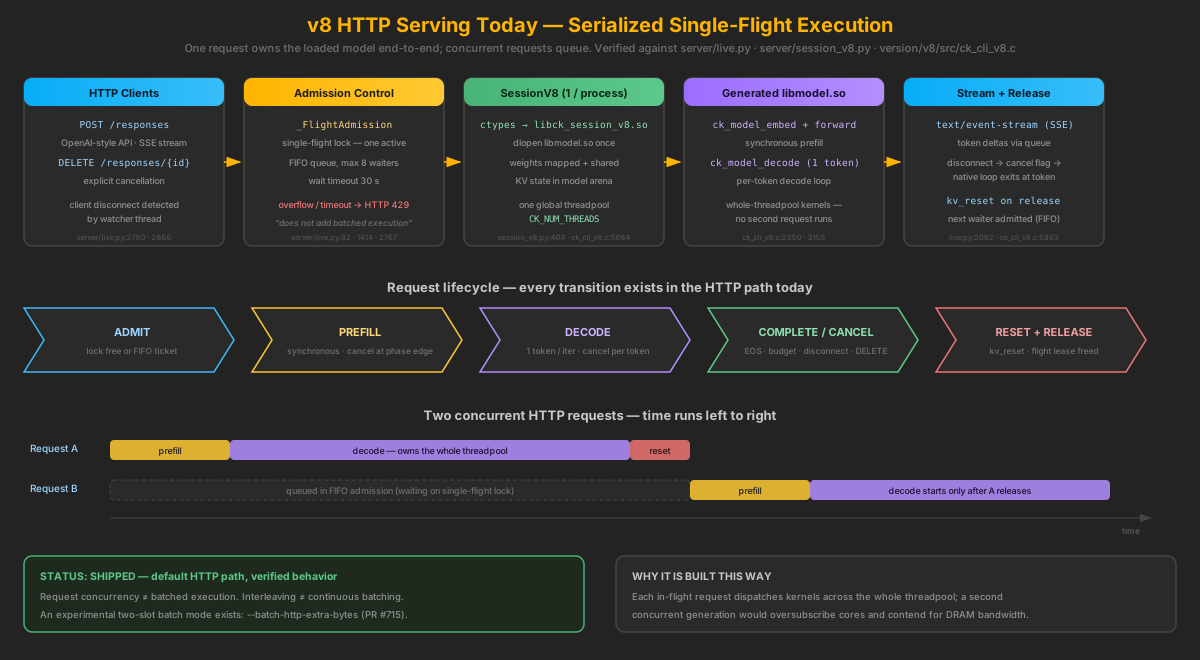
Default: serialized single-flight serving
Without batch flags, one request owns the loaded model end to end. A bounded FIFO queue (8 waiters, 30 s timeout) absorbs bursts and returns HTTP 429 beyond that. This is deliberate: each in-flight request already dispatches kernels across the whole threadpool, so a second concurrent generation would oversubscribe cores and contend for DRAM bandwidth rather than speed anyone up.
Experimental: two-slot batched decode (batch2)
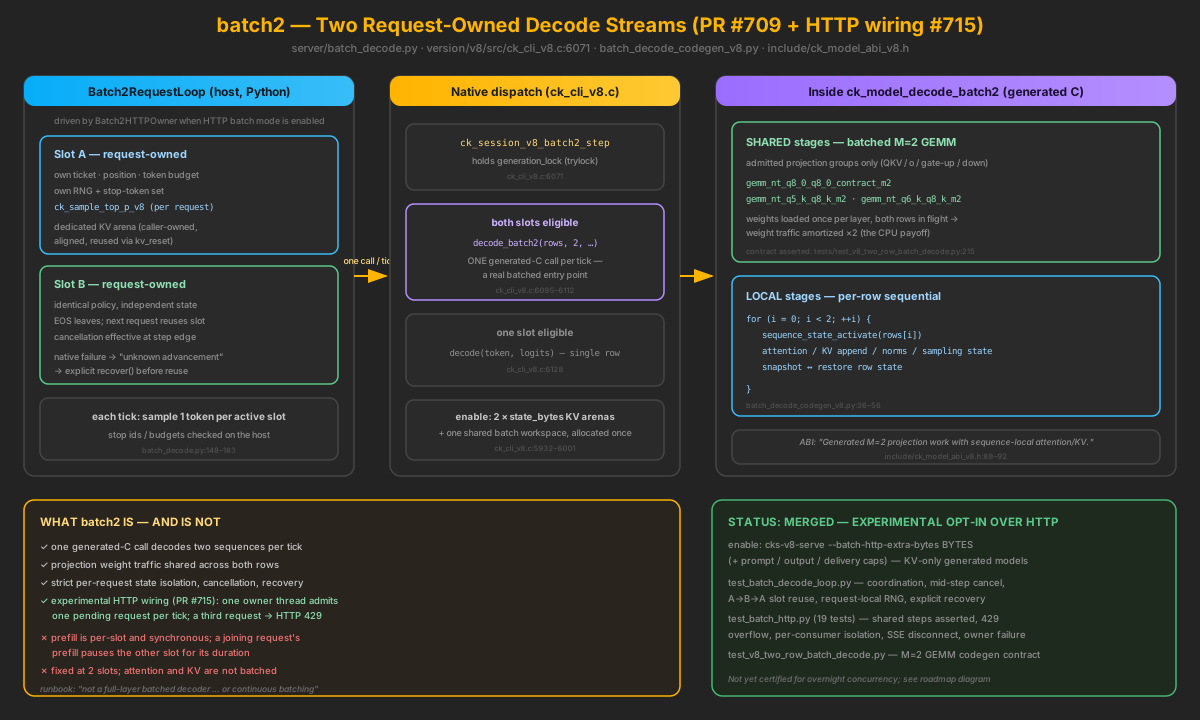
Merged in PR #709 (native/host loop) and PR #715 (HTTP wiring). When enabled, two requests can share one generated-C decode call per tick: projection GEMMs run batched at M=2 with weights loaded once, while attention, KV writes and positions stay sequence-local. A host-side loop keeps sampling, stop rules and budgets strictly per request.
# master switch plus required caps (see runbook for the exact, current invocation)
cks-v8-serve … --batch-http-extra-bytes BYTES \
               --batch-http-prompt-cap TOKENS \
               --request-output-cap TOKENS
What you get
- Two requests decoded per generated-C step when both slots are active — counted by the owner as shared steps and asserted by tests.
- Projection weight traffic amortized across both rows — the real CPU payoff.
- Per-request isolation: separate KV arenas, RNG, stop rules, output caps, cancellation and failure recovery.
- Bounded admission: a third concurrent request receives HTTP 429; delivery queues are bounded so a slow consumer cannot stall the owner.
What you do not get
- Not a full-layer batched decoder: attention and KV are per-row sequential inside the call.
- Prefill stays synchronous and per-slot — a joining request's prefill pauses the other slot for its duration; the prompt cap bounds tokens, not time.
- Fixed at two slots, KV-cache-only generated models (recurrent-state models are outside this capability).
- Not yet certified for sustained/overnight concurrency — treat as experimental.
Planned: continuous batching
The design direction is iteration-level scheduling over the generated runtime: an active set whose membership changes at every decode boundary, memory-aware admission against a shared KV pool, mixed/chunked prefill, and batched attention across N rows. batch2 is the N=2 proof of the ABI shape — the per-request policy model, arena reuse and recovery discipline generalize; the scheduler, batch-N codegen and paged KV do not exist yet.
Memory behavior under concurrency
Weights are mapped once per server process and shared by every request. Per-request cost is KV cache (and, for hybrid models, recurrent state) plus delivery buffers:
KV bytes ≈ 2 × KV-owning layers × KV heads × head dim × tokens × bytes/element
That approximation hides important detail: distinct KV storage owners (not layer count), grouped-query geometry, sliding-window layers, hybrid/recurrent state, alignment and cache layout. Use the Model Sizing Lab for an architecture-aware estimate. Also distinguish four different limits: maximum resident requests by memory, maximum active decode slots (2 in batch mode), queue capacity, and the sustainable concurrent workload — they are not interchangeable.
Performance: what to expect, and what not to claim
On CPUs, decode is usually memory-bandwidth-bound. Batching two rows shares each weight read across both sequences, so aggregate tokens/s can rise — while per-request rate can fall, and prefill interference adds latency for a joining request. Whether batch2 helps a given deployment depends on model size, quantization, context distribution and thread count. There are no published continuous-batching benchmarks for CKE yet; do not cite throughput claims without them. Measure prefill and decode separately, at fixed threads, with warm-up, and report aggregate throughput and per-request latency as distinct numbers.
Model-specific boundaries
Serving behavior is per generated artifact, not per server. The batch2 path currently
requires a generated KV-only batch-capable model layout, and enable_batch2 fails
at startup otherwise — the server refuses to boot in batch mode rather than silently
degrading. Recurrent-state models (e.g. DeltaNet-style layers), vision-language bridges and
audio pipelines have different state ownership and are outside the batch2 capability today;
their single-flight serving follows the default path. For the per-circuit record of which
models carry serving declarations and certification evidence, see the
v8 Serving Coverage Inventory.
Evidence and sources
- Serving layer:
server/live.py·server/batch_http.py·server/batch_decode.py·server/session_v8.py·server/README.md - Native bridge:
version/v8/src/ck_cli_v8.c(session, batch2 step, KV arenas, cancel) ·include/ck_model_abi_v8.h·include/ck_session_v8.h - Codegen:
version/v8/scripts/batch_decode_codegen_v8.py(shared M=2 GEMM stages vs per-row local stages) - Tests:
server/tests/test_batch_http.py·server/tests/test_batch_decode_loop.py·server/tests/test_serving_lifecycle_hardening.py·tests/test_v8_two_row_batch_decode.py - Operator docs: v8 runbook (incl. Experimental batch HTTP) · Model Sizing Lab · v8 Serving Coverage Inventory (per-circuit certification evidence)
Page authored against origin/main ce70528cd (post PR #709/#715) by source inspection; runtime claims rest on the cited tests, not on new benchmarks run for this page.