System Architecture
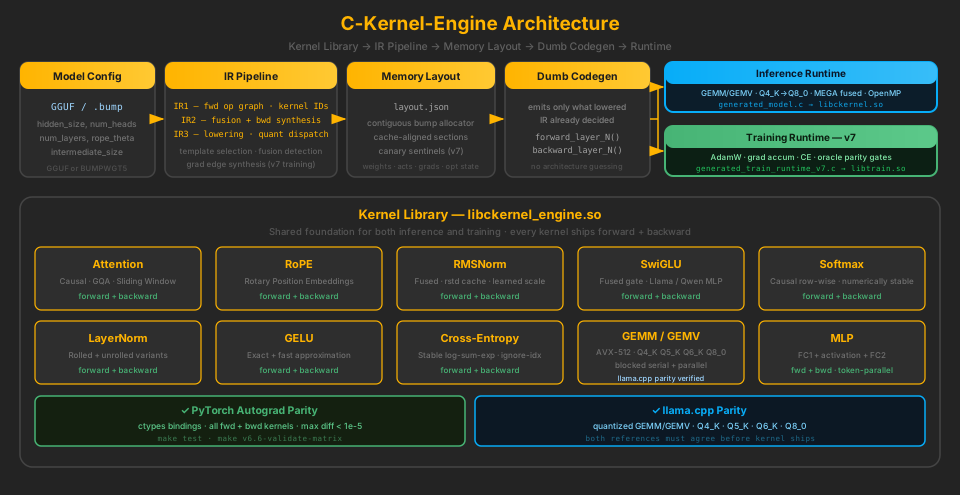
C-Kernel-Engine uses a three-stage pipeline to transform model configurations into optimized C runtimes.
New: See the IR Pipeline v6.6 page for end-to-end visuals of templates, IR1/IR2, lowering, memory layout, and dumb codegen.
Performance Methodology: See Kernel Tuning Methodology for the VTune, Advisor, roofline, CK profile, parity, and E2E workflow used to push generated kernels toward CPU-node limits.
v8 Compiler Hardening: See v8 Numerical Contracts for circuits, kernel-map capabilities, explicit attention reductions, deterministic resolution, generated-artifact equivalence, and parity promotion gates. See Kernel Maps and Provider Selection for how the resolver picks a physical provider per op and how the legacy migration is tracked.
Active v8 Compiler Architecture
The active v8 inference compiler consumes three authoritative inputs: model weights, an architecture circuit, and executable kernel maps. The circuit owns graph structure and required semantics. Kernel maps own ABI and implementation capability. The DSL resolves and stitches; generated C does not guess.
This boundary is executable policy, not only documentation. The v8 and v7 DSL audits reject new model-family dispatch in generic compiler/codegen functions, including dispatch hidden behind local aliases. Exact kernel operations do not fall back to broader families, malformed per-layer dimensions fail, and circuit weight policies are schema validated. New-model support must therefore extend a circuit, a kernel map, or a tested kernel instead of accumulating another compiler conditional. Multimodal families go further and compose circuits — see Kernel Architecture — Composite Circuits for the extends / components / stitch mechanism.
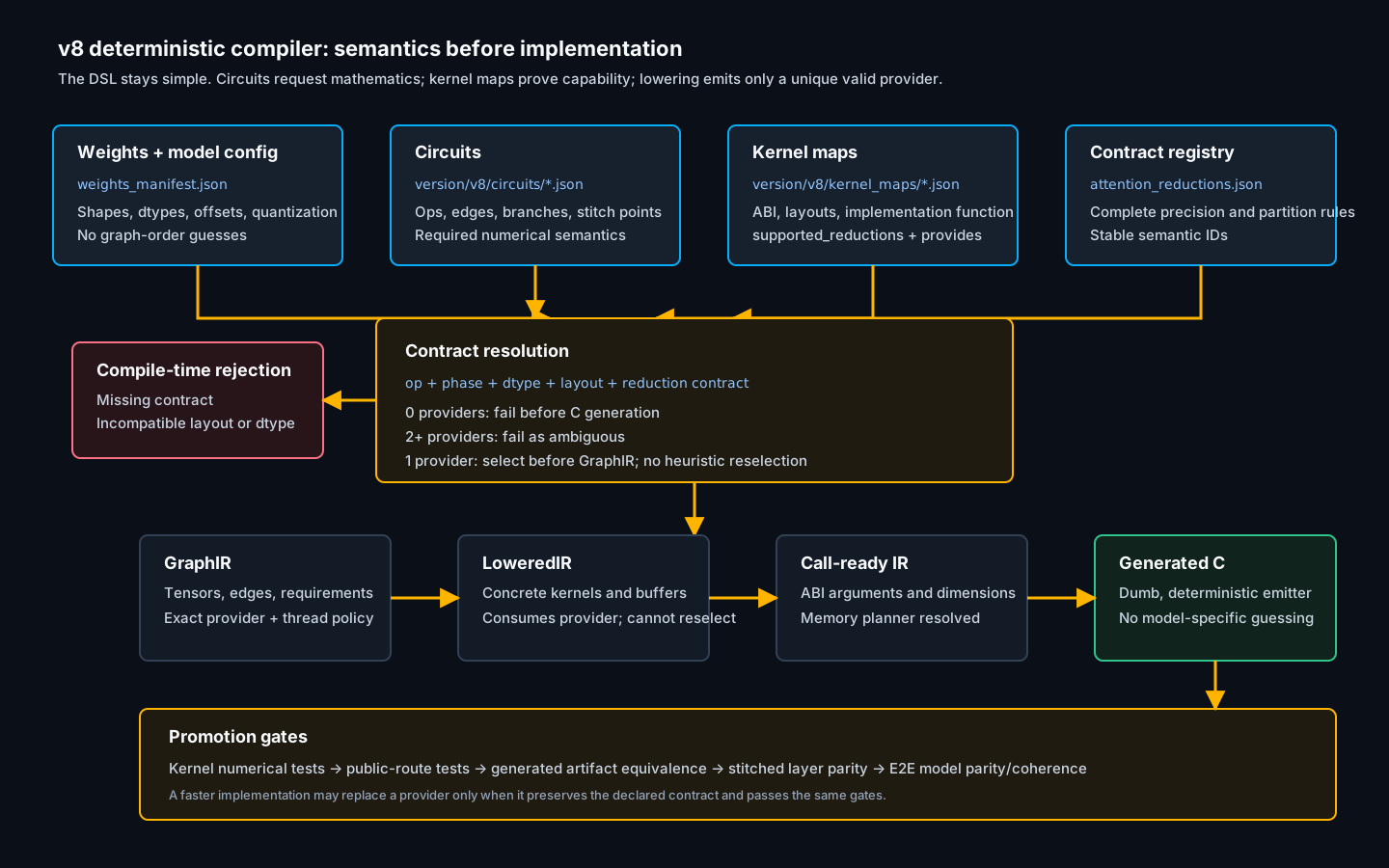
Compiler Input
weights + circuits + kernel maps
             ↓
deterministic DSL lowering
             ↓
generated C
Model definitions live in version/v8/circuits/. The historical embedded BUMP key remains template for serialized compatibility.
Semantic Selection
Precision-sensitive operations declare required_contracts. Real kernel maps advertise provides and supported_reductions. Missing and ambiguous providers are compile-time errors.
Authoritative Resolution
The resolver selects the compatible kernel and contract before GraphIR construction. GraphIR records that decision; LoweredIR, call-ready IR, and generated C must preserve it without fallback or reselection.
Promotion Gate
Leaf tests are necessary but insufficient. Public routing, threaded thresholds, stitched layer boundaries, full replay, persistent decode, and E2E behavior must agree before production validation.
Why reduction is architecture
Attention is not fully specified by softmax(QKᵀ)V. Q/K rounding, score accumulation, online-softmax state, V accumulation, split thresholds, partial storage, and merge order can change logits. v8 records these as complete contracts instead of inferring them from strict-mode flags, cache dtypes, sequence lengths, or thread counts.
Why threading is a kernel capability
Threading metadata applies across attention, GEMM, GEMV, and other parallel operators. Kernel maps declare the runtime, work partition, dispatch mechanism, and whether parallel order changes a reduction. The performance planner may choose among semantically compatible implementations, but it cannot silently change accumulation order to gain speed.
The "Website" Metaphor
The engine treats LLMs like a website generator treats pages. This allows us to unroll the "Block" section efficiently in C without complex control flow.
| Section | Website | LLM |
|---|---|---|
| Header | <head>, Nav, CSS | Embeddings, Positional Encoding |
| Block | Blog Posts, Articles | Transformer Layers (repeated) |
| Footer | Copyright, Scripts | Final Norm, Language Head |
Operator Spectrum Map
This view connects the data path (pretrain to RLHF/GRPO) with the compute path (math to inference/backprop) so operators can reason about the full stack in one place.
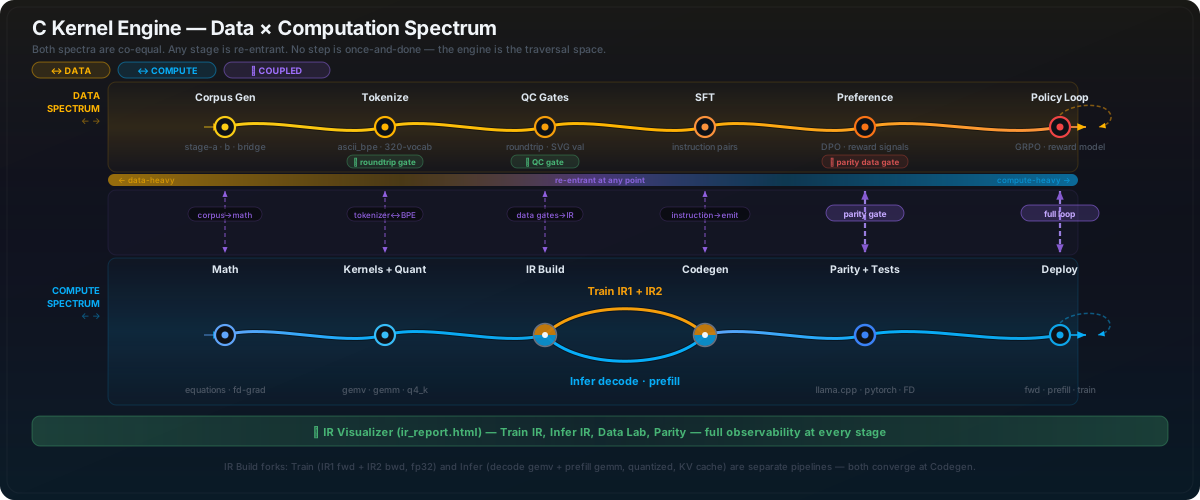
Data Runbook Links
- v7 SVG Dataset Runbook (Stage A and Stage B corpus generation)
- v7 Train + Inference Runbook (parity gates and train execution)
Computation Runbook Links
- IR Pipeline (IR1/IR2/lowering and memory mapping)
- Kernel Tuning Methodology (VTune, Advisor, roofline, CK profile, and parity gates)
- v7 Profiling (perf, flamegraph, cache, VTune/Advisor)
- v7 Backprop IR (gradient path and training runtime checks)
- Whisper Tiny End-to-End (generated audio encoder/decoder circuits from PCM16 WAV)
Stage 1: Model Configuration
The engine accepts HuggingFace-style config.json files as input:
{
  "hidden_size": 768,
  "num_attention_heads": 12,
  "num_key_value_heads": 4,
  "num_hidden_layers": 6,
  "intermediate_size": 2048,
  "rms_norm_eps": 1e-5,
  "rope_theta": 10000.0
}
This defines all the dimensions needed to generate layer structures.
Stage 2: Intermediate Representation
The IR Builder creates a structured representation of each layer:
CKLayerIR Structure
typedef struct {
    int layer_index;
    int embed_dim;
    int num_heads;
    int num_kv_heads;
    int head_dim;
    int intermediate_dim;
    int context_window;
    float eps;
    float rope_theta;
} CKLayerIR;
Key Decisions
- Aligned dimensions: Head dim padded to cache-friendly sizes
- GQA ratio: Computed from num_heads / num_kv_heads
- Buffer sizing: Calculated for all intermediate activations
Stage 3: Code Generation
The codegen emits complete C functions for forward and backward passes. The examples below are the v7-era training-lane output; for the current v8 pipeline (conversion → circuit → fail-closed kernel maps → staged IR → model_v8.c → libmodel.so) see Code Generation.
Generated Forward Pass
void forward_layer_0(
    const float *input,
    const ModelWeights *weights,
    LayerActivations *acts,
    const float *cos_cache,
    const float *sin_cache,
    int num_tokens
) {
    // 1. Pre-attention RMSNorm
    rmsnorm_forward(input, weights->ln1_gamma, acts->ln1_out, ...);

    // 2. QKV projection
    ck_qkv_project_head_major(acts->ln1_out, weights->wq, ...);

    // 3. Apply RoPE
    rope_forward_qk(acts->q, acts->k, cos_cache, sin_cache, ...);

    // 4. Attention
    attention_forward_causal_head_major_gqa(acts->q, acts->k, acts->v, ...);

    // 5. Output projection + residual
    // 6. Post-attention RMSNorm
    // 7. MLP (SwiGLU)
    // 8. Final residual
}
Generated Backward Pass
void backward_layer_0(
    const float *d_output,
    const ModelWeights *weights,
    const LayerActivations *acts,
    WeightGradients *grads,
    float *d_input
) {
    // Reverse order of forward pass
    // Each kernel uses saved activations from forward

    // 1. Backward through final residual
    // 2. Backward through MLP (SwiGLU)
    // 3. Backward through RMSNorm 2
    // 4. Backward through attention output projection
    // 5. Backward through attention
    attention_backward_causal_head_major_gqa(d_attn_out, acts->q, ...);

    // 6. Backward through RoPE (inverse rotation)
    rope_backward_qk(d_q, d_k, ...);

    // 7. Backward through QKV projection
    // 8. Backward through RMSNorm 1
}
Memory Layout
Q/K/V use
[num_heads, num_tokens, head_dim] layout for cache-efficient attention computation.
| Buffer | Layout | Size |
|---|---|---|
input |
[B, T, D] | batch * tokens * embed_dim |
Q |
[H, T, d_k] | num_heads * tokens * head_dim |
K, V |
[H_kv, T, d_k] | num_kv_heads * tokens * head_dim |
scores |
[H, T, T] | num_heads * tokens * context_window |
mlp_hidden |
[T, 2*I] | tokens * 2 * intermediate_dim |
The same fixed-offset discipline is the precondition for Memory Tetris, a research-stage design (not implemented) that would reuse dead arena slots as final destinations for tensors prefetched from NVMe.
Kernel Composition
Kernels are composed following transformer layer structure:
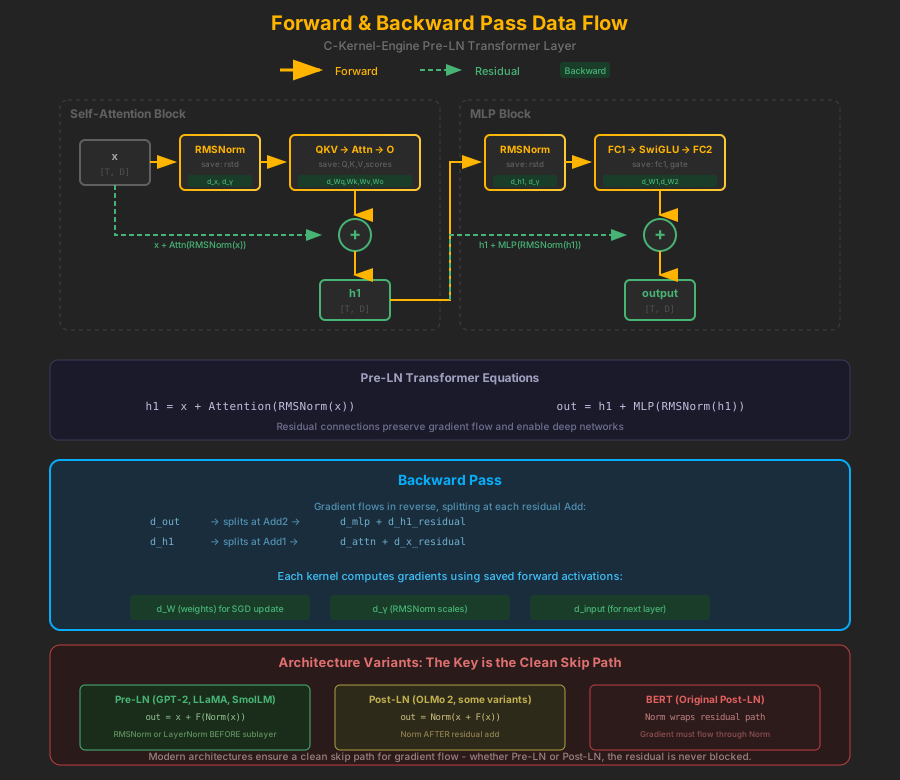
Build System
Full Library
make
Builds libckernel_engine.so with all kernels linked together.
Per-Kernel Libraries
make libckernel_attention.so
make libckernel_rope.so
make libckernel_rmsnorm.so
Builds individual kernel libraries for testing.
Codegen Pipeline
Generate Runtime from Config
# Build the IR demo tool
make build/ck_ir_demo

# Generate C runtime
./build/ck_ir_demo config.json --emit build/model.c

# Or use the make target
make ck-emit CONFIG=config.json OUT=build/model.c
The generated file contains:
- Buffer allocation functions
- Forward pass for all layers
- Backward pass for all layers
- Parameter gradient accumulation
Project Structure
The codebase is organized for easy navigation:
src/kernels
`-- fused
version/legacy/v6.6
|-- configs
|-- include
|-- kernel_maps
|-- legacy_kernel_maps
|   `-- kernels
|-- patches
|-- scripts
|   `-- parity
|-- src
|   |-- generated
|   |-- kernel_config
|   |-- scripts
|   `-- test_generated
|-- templates
|-- test
|-- tests
|-- tools
`-- unittest
version/v7
|-- artifacts
|   `-- svg_dsl
|       |-- gen1_archive_2026-04-05
|       `-- spec_archive_2026-04-08
|-- ckernel_engine
|   |-- python_authoring
|   |-- v7
|   `-- v8
|-- contracts
|-- data
|   |-- eval_contracts
|   |-- spec03
|   |   |-- contracts
|   |   |-- holdout
|   |   |-- manifests
|   |   |-- midtrain
|   |   |-- normalized
|   |   |-- pretrain
|   |   |-- raw_assets
|   |   |-- sft
|   |   `-- tokenizer
|   `-- spec04
|       |-- contracts
|       |-- holdout
|       |-- manifests
|       |-- normalized
|       |-- raw_assets
|       `-- tokenizer
|-- docs
|-- examples
|-- experiments
|   `-- svg_dsl
|-- include
|-- kernel_maps
|-- regression
|-- reports
|   |-- spec12_gold_mappings -> ../artifacts/svg_dsl/spec_archive_2026-04-08/spec12_gold_mappings
|   |-- spec13b_gold_mappings -> ../artifacts/svg_dsl/spec_archive_2026-04-08/spec13b_gold_mappings
|   |-- spec14a_gold_mappings -> ../artifacts/svg_dsl/spec_archive_2026-04-08/spec14a_gold_mappings
|   |-- spec14b_gold_mappings -> ../artifacts/svg_dsl/spec_archive_2026-04-08/spec14b_gold_mappings
|   |-- spec15a_gold_mappings -> ../artifacts/svg_dsl/spec_archive_2026-04-08/spec15a_gold_mappings
|   |-- spec15b_gold_mappings -> ../artifacts/svg_dsl/spec_archive_2026-04-08/spec15b_gold_mappings
|   |-- spec_broader_1_family_packs -> ../artifacts/svg_dsl/spec_archive_2026-04-08/spec_broader_1_family_packs
|   `-- spec_broader_1_gold_mappings -> ../artifacts/svg_dsl/spec_archive_2026-04-08/spec_broader_1_gold_mappings
|-- scripts
|   |-- dataset
|   `-- parity
|-- src
|-- templates
|-- test
|-- tests
|   |-- contracts
|   `-- fixtures
`-- tools
    `-- src

77 directories