Deep Dive: LLM Concepts
This page explains the key concepts, algorithms, and computational techniques used in modern Large Language Models. Understanding these fundamentals helps you know why each kernel exists and how they fit together.
Each section includes: conceptual explanation, where it fits in the architecture, the math, and our C implementation.
Table of Contents
- Transformer Architecture Overview
- Dense vs Flash Next: One Decoder Block
- RoPE: Rotary Position Embedding
- RoPE Layouts: Pairwise vs Split-Half
- GLM-4 RoPE: Pairwise Partial Rotary
- Gemma4 RoPE: Per-Layer Direct Split-Half
- Attention Mechanisms
- Flash Attention
- Recurrent Attention and Gated DeltaNet
- Sliding-Window Attention
- Grouped Query Attention (GQA)
- Sparse / Query-Selected Attention (QSA)
- Normalization: RMSNorm vs LayerNorm
- Nemotron-H Hybrid Circuit
- Mamba2 Reference Kernels
- Mixture of Experts: Router + ReLU2 Experts
- Activations: ReLU2, SwiGLU, GeGLU, GELU
- Vision Patch Embedding
- — 1D Text vs 2D Vision Position (RoPE)
- Audio Frontend: WAV to Log-Mel to Conv Stem
- — Cross-Attention: Decoder Queries, Encoder Memory
- Weight Tying
- Hyper-Connections (Multi-Stream Residuals)
- Per-Layer Embedding (PLE)
Transformer Architecture Overview
Before diving into individual components, let's see where everything fits in a decoder-only transformer (like Llama, GPT).
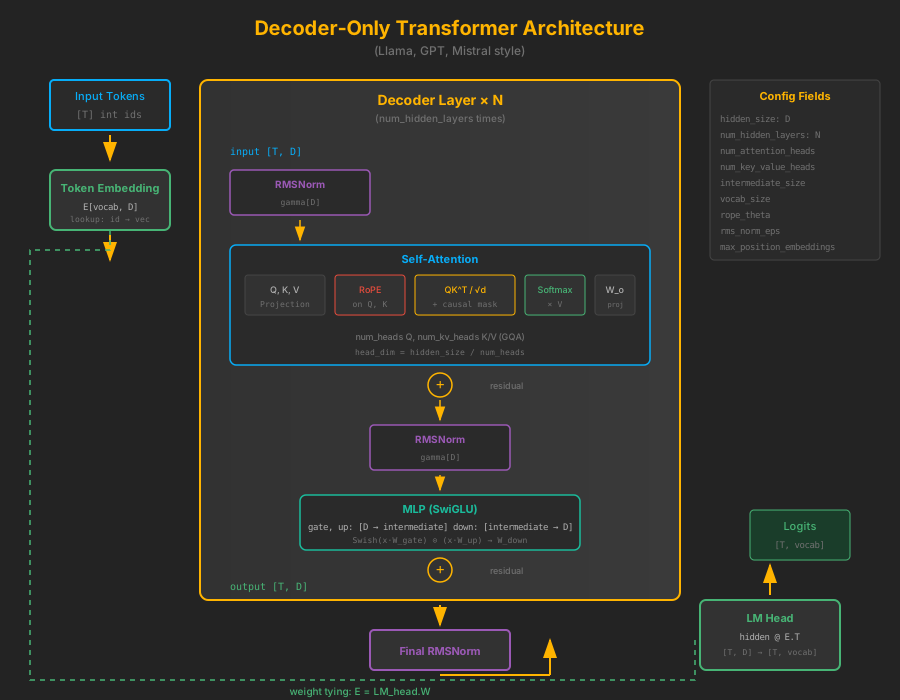
The Flow
- Token Embedding: Convert token IDs to vectors
- Position Encoding: Add position information (RoPE applied inside attention)
- N Decoder Layers, each containing:
- RMSNorm → Self-Attention → Residual Add
- RMSNorm → MLP (SwiGLU) → Residual Add
- Final RMSNorm
- LM Head: Project back to vocabulary (often weight-tied with embedding)
Dense vs Flash Next: One Decoder Block Side by Side
Two promoted v8 families share the decoder-block skeleton but differ in almost every contract inside it. Qwen3.8 27B Dense keeps a single residual stream, alternates gated-DeltaNet recurrent layers with full-attention layers, and runs one dense SwiGLU MLP. Qwen3.8 Flash Next carries four hyper-streams, chooses a DeltaNet-recurrent or QSA-sparse branch per layer, routes tokens through packed experts plus a gated shared expert, and injects a Per-Layer Embedding side input. The block below is representative, not exhaustive — each box links (in the caption) to the concept section that teaches it.
Read each box in depth: recurrent attention / gated DeltaNet · full attention · SwiGLU · hyper-connections · QSA · MoE routing · PLE. Naming caveat: “Flash” in “Qwen3.8 Flash Next” is the model family name, not the Flash Attention algorithm — the full-attention algorithm on this page is an unrelated, older idea.
RoPE: Rotary Position Embedding
RoPE encodes position information by rotating query and key vectors based on their position in the sequence. Unlike absolute position embeddings, RoPE naturally captures relative position.
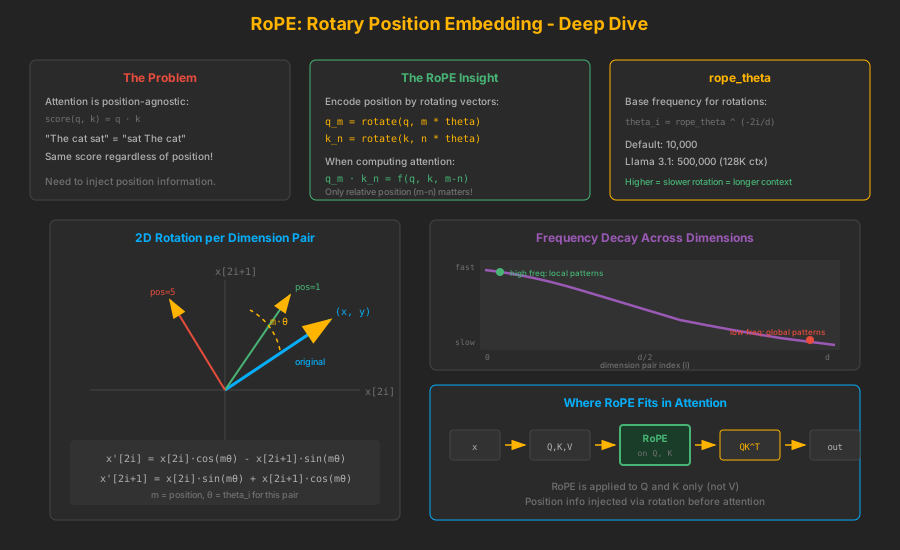
With RoPE, you go straight from token embedding to decoder layers. There's no separate
position_embed to add. Position is injected via rotation inside each attention layer.
The Flow with RoPE
Traditional (GPT-2 style):
  token_embed + position_embed → layers

With RoPE:
  token_embed → layers (RoPE applied inside attention)

Token: "The"  "cat"  "sat"  "on"   "mat"
Pos:     0      1      2      3      4

Embedding lookup (NO position added):
  [vec0] [vec1] [vec2] [vec3] [vec4]
           |
      Decoder Layer
           |
      Q, K, V projection
           |
    +---------------------------+
    |  RoPE: rotate Q and K     |
    |  Q_0 rotated by 0*theta   |
    |  Q_1 rotated by 1*theta   |
    |  Q_2 rotated by 2*theta   |
    |  (same angles for K)      |
    +---------------------------+
           |
      Attention: Q @ K.T (now position-aware!)
What is rope_theta?
rope_theta (default: 10000) is the base frequency that controls how quickly positions rotate through the embedding space.
theta_i = rope_theta ^ (-2i / d)

For d=64, i=0:  theta = 10000^0 = 1
For d=64, i=16: theta = 10000^(-0.5) = 0.01
For d=64, i=31: theta = 10000^(-0.97) ~ 0.0001
Higher rope_theta = slower rotation = better for long contexts
(Llama 3.1 uses 500,000 for 128K context)
Position vs Dimension
Both are involved, but differently:
angle(pos, dim) = position * theta_i
| Axis | What it controls |
|---|---|
| Position | How much to rotate (angle magnitude) |
| Dim pair | How fast to rotate (frequency) |
Dim pair 0: rotates FAST (local patterns)
Dim pair 31: rotates SLOW (global patterns)
Same Rotation for Q and K?
YES! At the same position, both Q and K get the same rotation:
At position m:
  Q_m = rotate(Q_m, angle = m * theta)
  K_m = rotate(K_m, angle = m * theta)

At position n:
  K_n = rotate(K_n, angle = n * theta)
The magic happens in the dot product...
Why Rotation Works
When you compute Q_m · K_n after rotation:
Q_m · K_n = f(Q, K, m - n)
Only the angle difference matters!
- Pos 5 → Pos 3: angle diff = 2*theta
- Pos 100 → Pos 98: angle diff = 2*theta
Same relative distance = same attention behavior.
RoPE Math
For each pair of dimensions (2i, 2i+1) at position m:
Forward:
    theta_i = rope_theta ^ (-2i / head_dim)
    angle = m * theta_i

    x'[2i]   = x[2i] * cos(angle) - x[2i+1] * sin(angle)
    x'[2i+1] = x[2i] * sin(angle) + x[2i+1] * cos(angle)

Backward:
    Simply rotate by negative angle (transpose of rotation matrix)
Our implementation: rope_kernels.c - precomputes cos/sin cache, applies in-place to Q and K
RoPE Layouts: Pairwise vs Split-Half
One subtle but critical detail: RoPE is not only about the angle schedule. You also need the correct channel pairing layout. Two models can use the same rope_theta, the same cache, and the same attention code, yet still diverge badly if they pair channels differently.
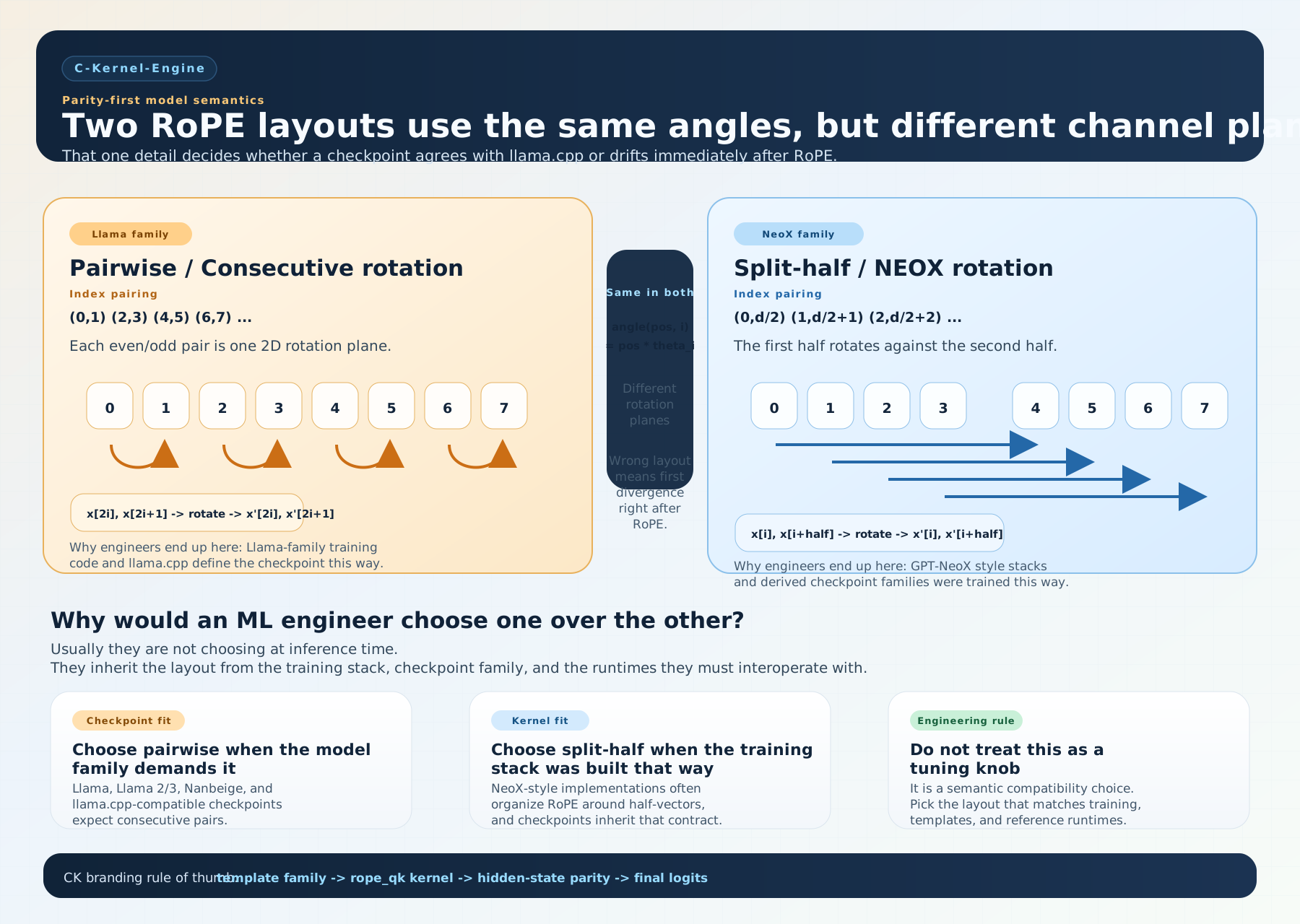
Pairwise / Consecutive RoPE
This is the layout used by Llama-family checkpoints, including Nanbeige in our v7 work, and by GLM-4 for its rotary slice.
(0,1), (2,3), (4,5), ...
Each even/odd pair is treated as one 2D rotation plane. That makes the math read exactly like the textbook RoPE formula:
x'[2i]   = x[2i] * cos - x[2i+1] * sin
x'[2i+1] = x[2i] * sin + x[2i+1] * cos
Practical upside: the rotation is easy to reason about as adjacent feature pairs. Practical requirement: if a Llama checkpoint gets the split-half layout by mistake, parity fails immediately after RoPE.
Split-Half / NEOX RoPE
This layout is common in GPT-NeoX-style implementations. In this engine's current templates, Qwen and Gemma follow this family.
(0, d/2), (1, d/2+1), (2, d/2+2), ...
The vector is split into two halves, then each index in the first half rotates against the matching index in the second half.
Practical upside: it fits naturally with split-vector implementations and long-standing NEOX-style kernels. Practical requirement: it is only correct for checkpoints trained with that layout.
Important: This is a checkpoint semantic, not a tuning preference
Neither layout is inherently "better" in the abstract. The model family decides which one is correct. The right question is not "which RoPE is stronger?" but "which RoPE layout was this checkpoint trained with?"
| Question | Correct framing |
|---|---|
| Do both use the same angles? | Yes, both use the same RoPE frequency schedule idea. |
| What changes? | Which channels are paired into each 2D rotation plane. |
| What breaks if you choose the wrong one? | Q/K differ right after RoPE, then attention and logits drift downstream. |
| What should parity tooling check? | Embedding output, then per-layer hidden states, then the first op that diverges. |
What is the actual difference?
The frequency schedule is the same idea in both cases. The actual difference is which channels form each rotation plane.
Pairwise:
  x[0] with x[1]
  x[2] with x[3]

Split-half:
  x[0] with x[d/2]
  x[1] with x[d/2+1]
That changes the rotated Q and K values immediately. If you get the layout wrong, attention will diverge even when embedding lookup, RMSNorm, and projection kernels are all correct.
Before training: how would an ML engineer choose?
If you are designing a model family from scratch, this choice is mostly about ecosystem fit and implementation coherence, not a proven universal quality advantage.
- Choose pairwise if you want a Llama-style family that should match llama.cpp, common Llama checkpoints, and adjacent even/odd rotation math.
- Choose split-half if you are building on a GPT-NeoX-style stack or existing kernels, loaders, and training code that already assume first-half/second-half pairing.
- Choose the stack you can support end-to-end: training code, checkpoint export, inference kernels, parity tooling, and debugging all need to agree.
For most teams, the practical decision is: pick the RoPE layout of the ecosystem you want to join. Bigger modeling choices usually matter more for quality than pairwise-versus-split-half by itself.
If you are still before training, RoPE layout is a family-level architecture choice. It should be decided alongside tokenizer, attention variant, GQA/MQA policy, context strategy, and runtime targets. Once you train, the layout becomes part of the checkpoint contract and changing it later is effectively a different model.
The older split-half path already has AVX/AVX-512 SIMD specialization. The pairwise path is selected through template/model-map metadata for model families that rotate adjacent even/odd pairs, including Llama-style layouts and GLM-4 partial RoPE. The direct split-half path was added for model families that need per-layer rotary parameters instead of one global cache contract.
GLM-4 RoPE: Pairwise Partial Rotary
What changed for GLM-4?
GLM-4 uses the pairwise/interleaved RoPE layout, but only on the configured rotary slice of each attention head. For example, with a 128-dimensional head and a 64-dimensional rotary slice, CK rotates adjacent pairs inside the first 64 dimensions and leaves the remaining 64 dimensions unchanged.
Pairwise partial RoPE:
  rotate:      (x0, x1), (x2, x3), ... within rotary_dim
  pass-through: dimensions rotary_dim .. head_dim-1

GLM template/model map:
  rope_layout       = pairwise
  partial_rotary    = true
  rope_qk override  = rope_forward_qk_pairwise
This is a model compatibility feature, not a tuning knob. If GLM-4 is lowered with split-half RoPE, the projection kernels can still be correct, but Q/K diverge immediately after RoPE and the attention output drifts from PyTorch.
How CK controls this
The GLM template declares the circuit-level RoPE policy with rope_layout: "pairwise" and the safetensors model map carries the same architecture contract. Lowering reads that metadata and emits rope_forward_qk_pairwise for the Q/K rotary operation. The kernel itself is generic: it implements pairwise partial rotary math and does not know that the caller is GLM.
This keeps the DSL/compiler path deterministic. Templates and model maps describe the semantic contract; kernel maps bind that contract to an implementation; generated C should not infer or guess the rotary convention from tensor shape alone.
Gemma4 RoPE: Per-Layer Direct Split-Half
What changed for Gemma4?
Gemma4 still uses the split-half rotation layout, but it is not the same runtime contract as a plain global split-half cache. Different layer kinds can carry different rotary settings, so CK now treats RoPE as layer metadata instead of a hard-coded model special case.
template/gemma4.json
  attention_contract.rope_param_mode = per_layer_direct
  layer_rope_kind[]                  = full | sliding
  layer_rotary_dim[]                 = per-layer rotary width
  rope_theta / rope_theta_swa        = per-kind frequency base

lowered IR
  rope_qk = rope_forward_qk_split_direct
  attrs carry the layer rotary contract

kernel map
  rope_forward_qk_split_direct -> rope_forward_qk_split_direct_f32
The important distinction is semantic: sliding_window controls the attention mask/cache window. It does not tell the runtime which rotary base, rotary dimension, or layer-specific RoPE stream to use. Those are explicit IR attributes.
Why this is not hard-coded
The Gemma4 template exports the contract as data. The DSL/lowering path reads that data and emits a generic rope_forward_qk_split_direct op. The C kernel is not named after Gemma4 and can be reused by another architecture that needs split-half rotation with direct per-layer parameters.
This is the same compatibility pattern used elsewhere in CK: model templates describe graph semantics; lowered IR carries concrete kernel attributes; kernels implement math contracts without owning model policy.
Attention Mechanisms
Attention is the core of transformers: it lets each token "look at" all other tokens and decide what's relevant.
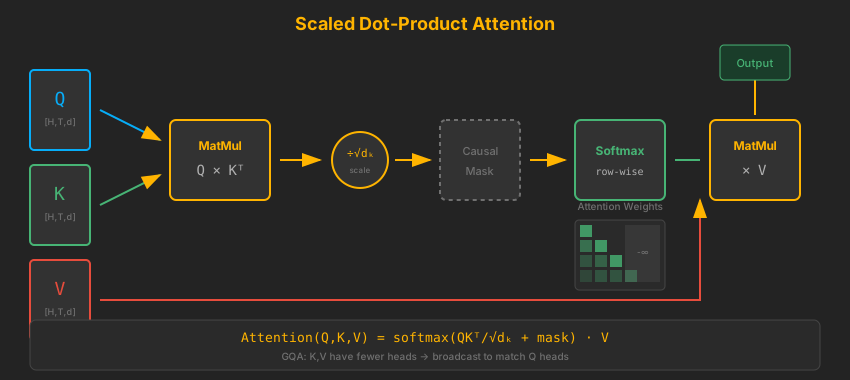
Attention Math
1. Project input to Q, K, V:
   Q = input @ W_q    # What am I looking for?
   K = input @ W_k    # What do I contain?
   V = input @ W_v    # What do I offer?

2. Compute attention scores:
   scores = Q @ K.T / sqrt(d_k)    # How relevant is each position?

3. Apply causal mask (decoder only):
   scores[i][j] = -inf if j > i    # Can't look at future tokens

4. Softmax to get weights:
   weights = softmax(scores)       # Normalize to probabilities

5. Weighted sum of values:
   output = weights @ V            # Aggregate information
Why Scale by sqrt(d_k)?
Without scaling, dot products grow with dimension size, pushing softmax into saturation (all attention on one token). Scaling keeps gradients healthy.
d_k = 64:  scale = 1/8 = 0.125
d_k = 128: scale = 1/11.3 ≈ 0.088
Flash Attention
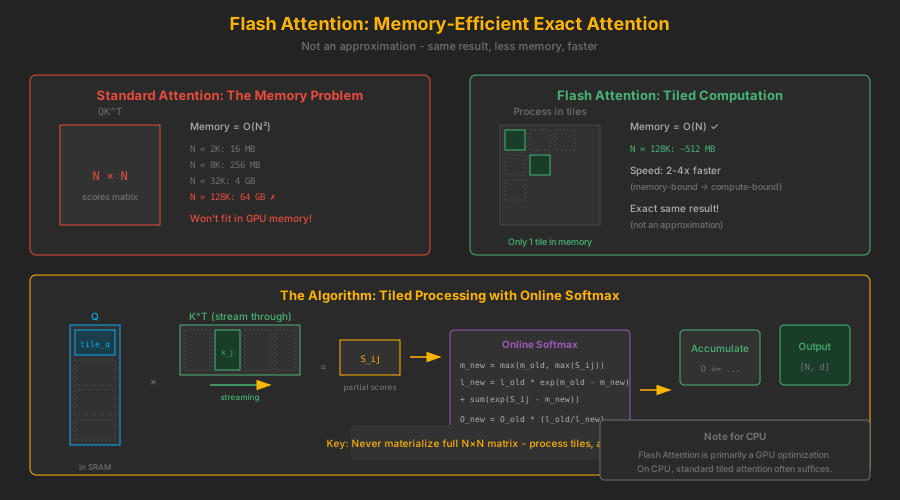
Flash Attention is an algorithmic optimization that computes exact attention without materializing the full N×N attention matrix. It's about memory efficiency, not approximation.
The Problem
Standard attention materializes the full score matrix:
scores = Q @ K.T  # [N, N] matrix!

N = 2048:  16 MB
N = 8192:  256 MB
N = 32768: 4 GB
N = 131072: 64 GB  # Won't fit in GPU!
Memory is O(N²), which limits context length.
Flash Attention Solution
Process in tiles, never storing full N×N matrix:
- Load Q tile to fast SRAM
- Stream K, V tiles through
- Compute partial softmax with online algorithm
- Accumulate output incrementally
Memory: O(N) instead of O(N²)
Speed: 2-4x faster (memory-bound → compute-bound)
Online Softmax Trick
The key insight: you can compute softmax incrementally without seeing all values first.
Traditional: softmax(x) = exp(x) / sum(exp(x))  # Need all x first

Online (Flash):
    For each new block of scores:
        1. Update running max: m_new = max(m_old, max(block))
        2. Rescale previous sum: sum *= exp(m_old - m_new)
        3. Add new block contribution: sum += sum(exp(block - m_new))
        4. Update running output with correction factor
Key Insight: Flash Attention reduces memory traffic from O(N²) to O(N), making it valuable for any hardware where memory bandwidth is a bottleneck. The algorithmic improvement (online softmax + tiling) applies to both CPU and GPU.
📊 Performance Analysis: CPU Flash Attention
For a detailed comparison of CPU attention implementations (including benchmarks vs llama.cpp's ggml), see:
Flash Attention Analysis: Why llama.cpp is Faster
Covers SIMD optimizations, threading strategies, and performance trade-offs across different workloads (small vs large models, different context lengths).
Recurrent Attention and Gated DeltaNet
Some hybrid architectures avoid scanning a full KV-cache on every layer by carrying a compact recurrent state. In Qwen3.5/qwen3next-style layers, CK implements the Gated DeltaNet update as a dedicated kernel family rather than treating it as ordinary attention or a wrapper around GEMM.
Where to go next
The full recurrent update, state matrix semantics, gate placement, and CK kernel entry point are covered in the dedicated deep dive:
Gated DeltaNet: Recurrent Attention Deep Dive
Primary implementation: src/kernels/deltanet_kernels.c, exposed through gated_deltanet_autoregressive_forward().
A Second Hybrid Family: Qwen3.8 Flash Next
Nemotron-H (below) was the first hybrid family; Qwen3.8 Flash Next (PR #456, GGUF architecture qwen4exp, circuit version/v8/circuits/qwen4_exp.json) is the second. Its 48 layers interleave recurrent Gated DeltaNet layers with sparse full-attention layers (attention_topology: deltanet_or_qsa_sparse), wrap the residual path in a four-stream gated hyper-connection (residual_topology: four_stream_gated_hyper_connection), and replace the dense MLP with a packed MoE plus a gated shared expert (mlp_topology: packed_moe_plus_gated_shared_expert). See QSA, Hyper-Connections, and Per-Layer Embedding below.
Sliding-Window Attention
Sliding-window attention limits each query to the most recent W tokens. It is exact within the window, keeps compute linear in sequence length, and provides predictable latency for long contexts.
Windowed Causal Mask
For token i:
  attend j in [max(0, i - W + 1), i]

scores[i][j] = -inf if j > i
scores[i][j] = -inf if i - j >= W
Compute: O(N * W) vs O(N²). Memory stays O(N * D).
Why It Matters
- Long contexts without quadratic blow-up
- Stable decode latency (only last W KV entries)
- Works with Flash Attention (online softmax inside the window)
C-Kernel-Engine Implementation
We expose a dedicated op attention_sliding that uses the same head-major GQA layout as standard attention.
attention_forward_causal_head_major_gqa_flash_strided_sliding(prefill)attention_forward_decode_head_major_gqa_flash_sliding(decode)
The only difference from causal attention is the window bounds. The math and softmax remain exact inside the window.
Grouped Query Attention (GQA)
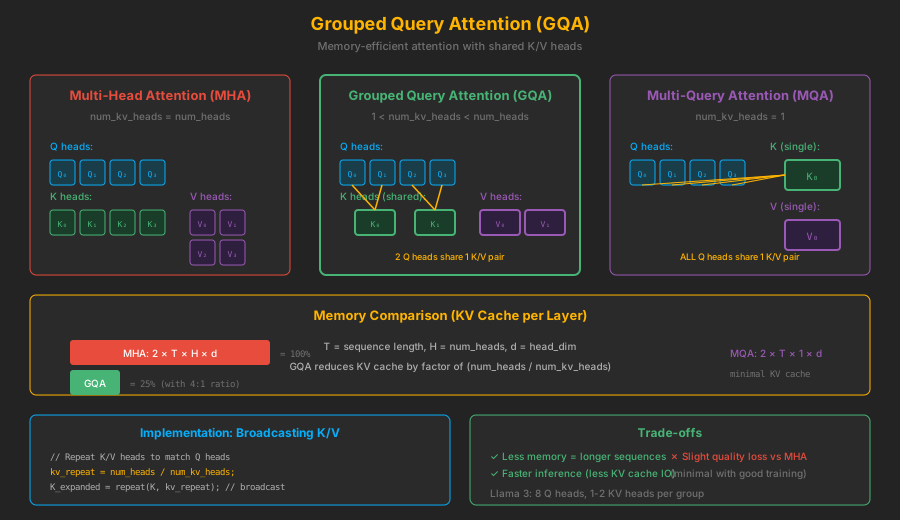
GQA reduces memory and compute by sharing K, V heads across multiple Q heads.
Why GQA?
| Type | Q Heads | K,V Heads | KV Cache Size | Model |
|---|---|---|---|---|
| MHA (Multi-Head) | 32 | 32 | 100% | GPT-3, Llama 1 |
| GQA | 32 | 8 | 25% | Llama 2 70B, Llama 3 |
| MQA (Multi-Query) | 32 | 1 | 3% | Falcon, PaLM |
GQA is the sweet spot: 4x smaller KV cache with minimal quality loss.
Sparse / Query-Selected Attention (QSA)
Qwen3.8 Flash Next (PR #456) introduces a second way to avoid full-prefix attention: instead of restricting each query to a fixed recent window, a cheap indexing pass scores blocks of the prefix and attention runs over only the selected token indices. This is content-based selection, complementary to sliding windows.
The Two-Stage Pipeline
- Index scoring (
qwen4_qsa_index_select_bf16,src/kernels/qwen4_exp_kernels.c): a small per-head RMSNorm + partial-RoPE index Q/K projection, with its own index-key cache, mean-pools keys into blocks (compress_ratio), scores the blocks, and keeps the top-k blocks — emitting atoken_budget-sized list of selected token indices. - Sparse attention (map
qsa_attention_bf16, interfaceqsa.sparse_attention.bf16.v1): GQA flash attention over only the gathered indices — online softmax over a BF16 cache, with an AVX-512F path insrc/kernels/attention_kernels.c.
Why It Saves Work
Full causal attention at position t:   O(t)   score+softmax+V reads
QSA at position t:                     O(token_budget)  (+ cheap index scoring)

KV bytes read per query drop from the full prefix
to token_budget gathered entries — decode stays fast
long after a full KV cache would be bandwidth-bound.
The trade-off: selection is approximate. The index pass must rank blocks well enough that the dropped tokens were safe to skip, so the index Q/K path has its own cache and normalization contract.
Normalization: RMSNorm vs LayerNorm
Normalization stabilizes training by keeping activations in a reasonable range.
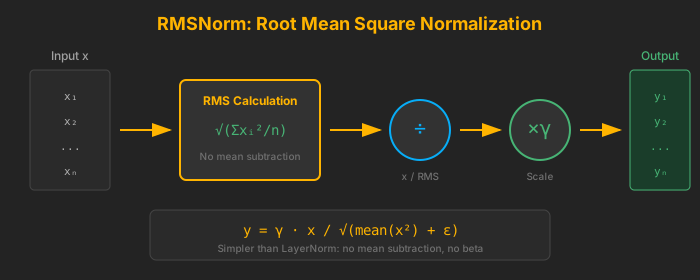
LayerNorm (Original)
mean = sum(x) / n
var = sum((x - mean)²) / n
y = gamma * (x - mean) / sqrt(var + eps) + beta
4 operations: mean, center, variance, normalize
Learnable: gamma (scale) and beta (shift)
RMSNorm (Simpler)
rms = sqrt(sum(x²) / n)
y = gamma * x / (rms + eps)
2 operations: RMS, normalize
Learnable: gamma only (no beta)
~15% faster, same quality
Why Remove Mean Centering?
Research found that the re-centering (subtracting mean) in LayerNorm isn't necessary for good performance. RMSNorm keeps just the scaling, which is what matters for gradient flow.
Used in: Llama, Mistral, Qwen, Gemma (most modern LLMs)
Nemotron-H Hybrid Circuit: Attention + Mamba2 + MoE
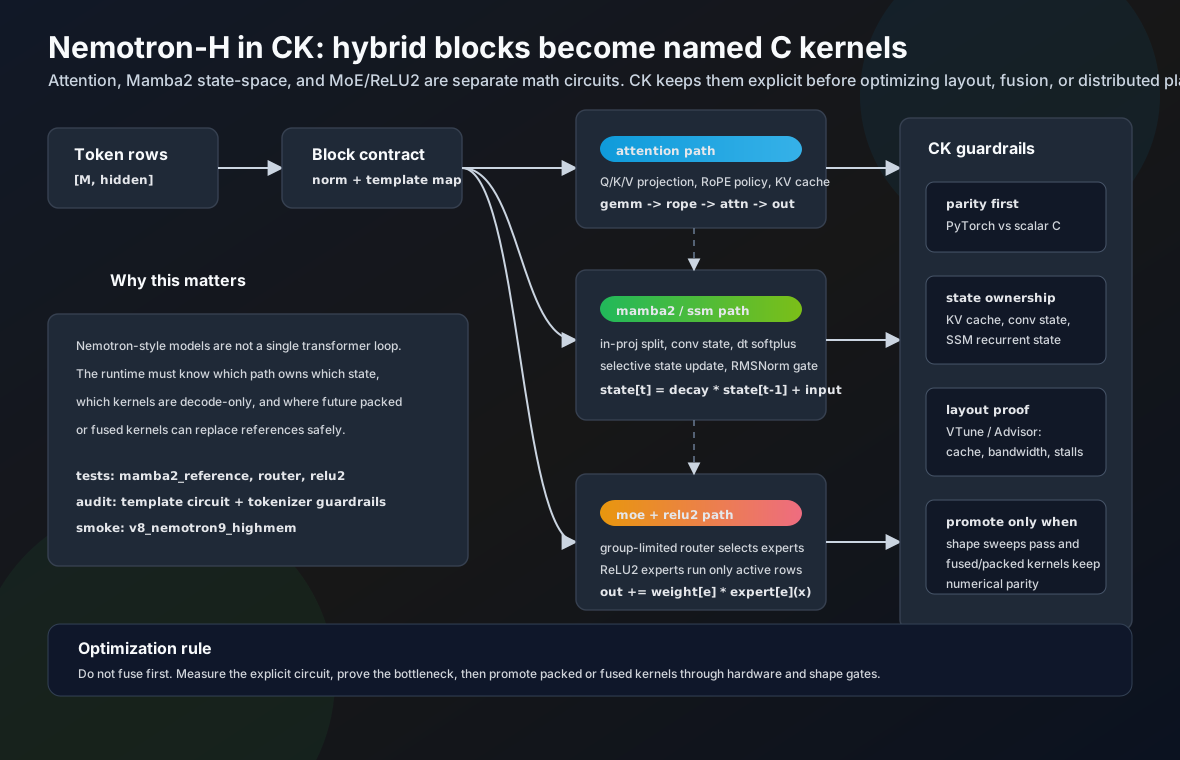
Nemotron-H is important for CK because it is not just another dense transformer stack. A single model family can mix attention layers, Mamba2-style state-space layers, routed MoE blocks, ReLU2 experts, tokenizer guardrails, and model-specific template rules. CK needs to represent that as an auditable circuit of named kernels before it becomes a high-performance runtime.
What CK Has to Preserve
The hard part is not only implementing the math once. The runtime has to preserve state ownership and layout contracts across different layer types:
- Attention: Q/K/V projection, RoPE or no-RoPE policy, KV-cache placement, and output projection.
- Mamba2 / SSM: input projection split, convolution state,
dtsoftplus, recurrent selective state update, and gated normalization. - MoE: group-limited routing, top-k expert selection, ReLU2 expert execution, and weighted accumulation.
Why Profiling Comes Before Fusion
VTune and Advisor are exactly the right tools here. They tell us whether a slow path is memory bandwidth, cache misses, branch pressure, vector under-utilization, bad thread placement, or true arithmetic cost. Only then should CK promote a fused kernel.
Good fusion candidates are real, but they should be gated:
- Q/K/V projection plus quantization or layout packing for prefill.
- Mamba2 in-proj split plus conv-state update plus
dtpreparation. - Selective scan chunks once scalar sequence parity is locked.
- Router plus expert dispatch when sparse row ownership is stable.
Current CK Coverage
The current Nemotron path is deliberately reference-first. make test-mamba2-reference validates Mamba2 decode and sequence-scan behavior. make test-nemotron-router validates group-limited routing. make test-moe-relu2-expert validates routed ReLU2 expert math. The v8 guardrail tests cover tokenizer capability codegen, template-circuit audit rules, and high-memory Nemotron smoke coverage behind make test-v8-nemotron9-highmem.
This is the right foundation for the next optimization phase: use profiling to decide which references become packed, tiled, SIMD, chunked, or fused kernels, without losing the ability to explain exactly which kernel changed.
Mamba2 Reference Kernels
Hybrid models such as Nemotron-H include Mamba2-style recurrent layers alongside attention and MoE blocks. These layers are not attention: they maintain a compact state, update it token by token, and use learned decay/input/output terms to produce the next hidden representation.
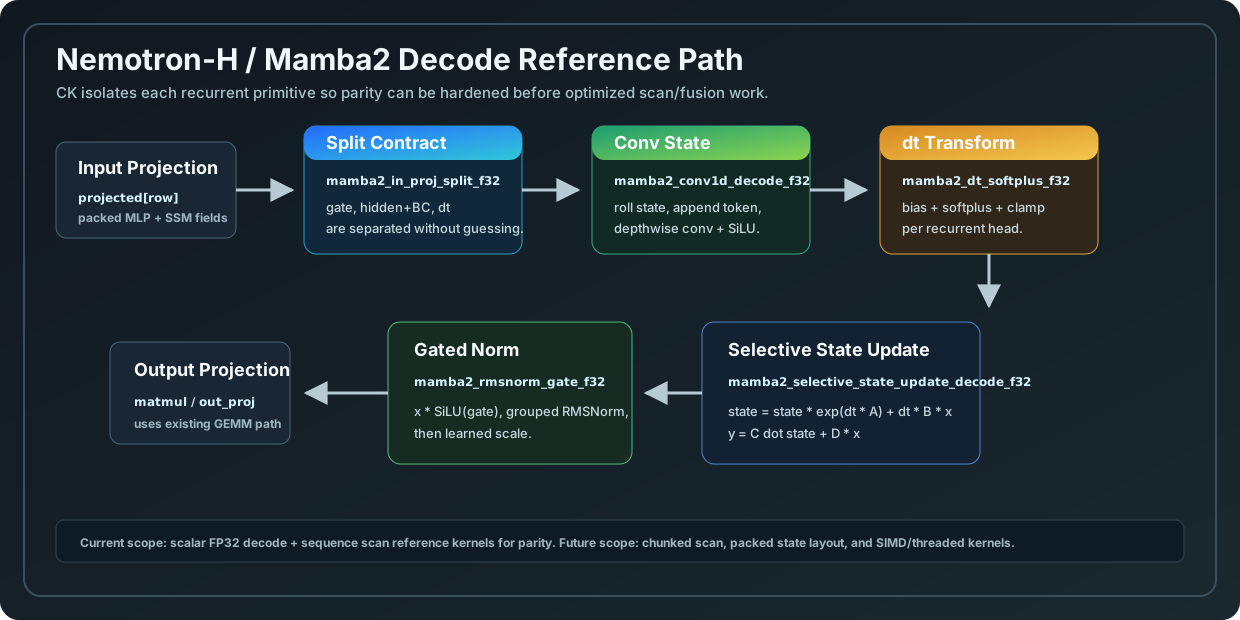
Decode Contract
projected -> split(gate, hidden_bc, dt)
conv_state = roll_append(conv_state, hidden_bc)
dt = softplus(dt + dt_bias)
state = state * exp(dt * A) + dt * B * x
y = C dot state + D * x
out = grouped_rmsnorm(y * silu(gate))
The important part is state ownership. CK exposes each step as a named kernel so the runtime can decide where state lives, how it is streamed, and which future optimized kernel replaces the scalar reference.
Why Reference First
Mamba2 performance work should not start as a fused black box. The scalar FP32 kernels define exact tensor layout, numerical behavior, and PyTorch parity before SIMD, tiling, chunked scan, or distributed state placement are introduced.
mamba2_in_proj_split_f32mamba2_conv1d_decode_f32mamba2_dt_softplus_f32mamba2_selective_state_update_decode_f32mamba2_selective_scan_f32mamba2_rmsnorm_gate_f32
Current CK Coverage
make test-mamba2-reference validates the decode primitives and scalar sequence scan against PyTorch. It also checks that full sequence scan matches repeated decode updates. make test-mamba2-reference-perf provides a scalar baseline for selective state update. This is enough to harden Nemotron-H recurrent contracts, but it is not yet the final high-performance chunked/SIMD selective scan.
Mixture of Experts: Router + ReLU2 Experts
MoE layers replace one dense MLP with a pool of experts and a router. For each token row, the router scores experts, selects a small top_k subset, runs only those expert MLPs, and accumulates the weighted result. This is sparse control flow wrapped around dense per-expert math.
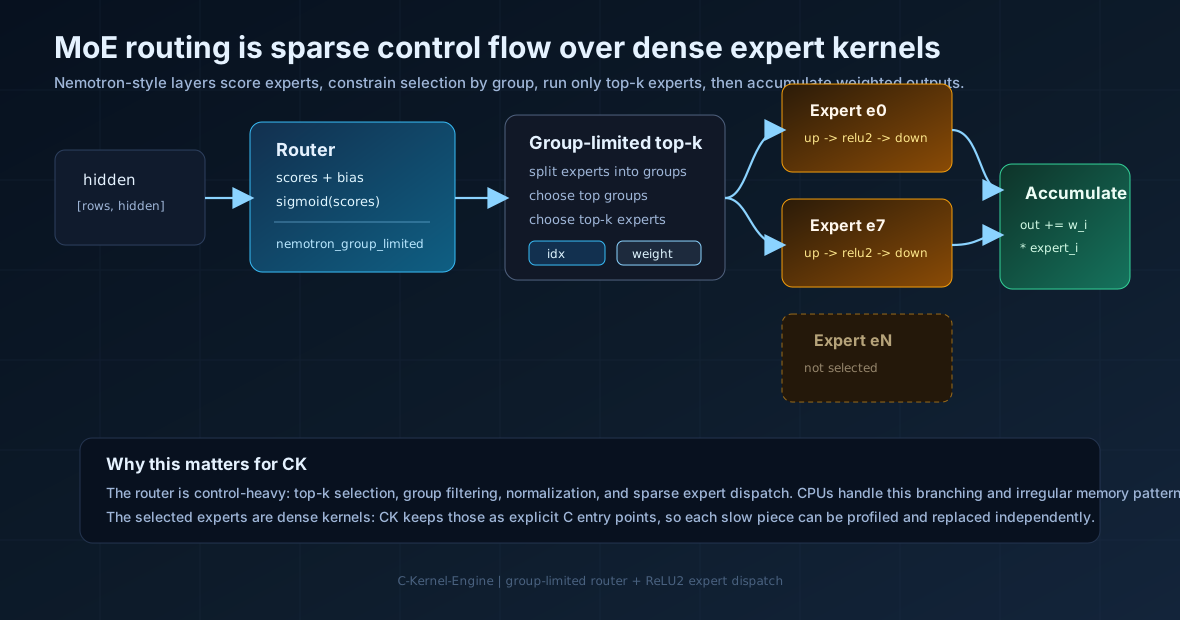
Group-Limited Top-K Router
scores = sigmoid(router_logits + correction_bias)
groups = partition(experts, n_group)
active_groups = topk(group_scores, topk_group)
experts = topk(scores inside active_groups, top_k)
weights = normalize(scores[experts])
The router is not just a matrix multiply. It includes bias correction, group selection, top-k selection, optional normalization, and a scaling factor before expert dispatch.
Routed ReLU2 Expert
for selected expert e:
  h1 = hidden @ W_up[e].T
  h2 = relu2(h1)
  y  = h2 @ W_down[e].T
  output += routing_weight[e] * y
The active experts are dense kernels. CK now has scalar reference coverage for the routed ReLU2 expert path, including backward parity and a performance benchmark.
Current CK Coverage
nemotron_group_limited_topk_router_f32for group-limited routing.moe_relu2_expert_forward_f32andmoe_relu2_expert_backward_f32for routed expert execution.make test-nemotron-router,make test-moe-relu2-expert, andmake test-moe-relu2-expert-perffor parity and speed checks.
On local AVX2 validation, the group-limited router microbenchmark measured CK at about 3.5x faster than the PyTorch reference, and the ReLU2 expert benchmark measured roughly 28-32x faster for the tested shapes. That does not mean full Nemotron inference is solved; it means these specific MoE primitives are now isolated, tested, and fast enough to build on.
Packed and Mixed-Quant Experts (Qwen3.8 Flash Next)
Qwen3.8 Flash Next (PR #456) adds two dispatch wrinkles beyond the classic router + dense-expert shape:
- Packed expert storage:
moe_swiglu_packed_expert_forward_bf16(src/kernels/axpy_kernels.c) keeps gate and up in one packed tensor per expert (stride2*I*H, up at offsetI*H), runs BF16-rounded gate/up GEMV, SwiGLU, down GEMV, then route-weighted accumulate. A candidate router mapmoe_softmax_topk_router_pytorch_bf16(priority 220, grouppytorch_full_softmax_topk_selected_renorm_bf16_storage) matches the PyTorch BF16 storage contract. - Mixed-quant routed experts:
moe_swiglu_expert_forward_q4k_q8_0andmoe_swiglu_expert_forward_q4k_q5_0pair Q4_K gate/up with Q8_0 or Q5_0 down projections — the weight format is selected per tensor by the kernel map, not hard-coded per model. See Quantization Formats for the byte layouts, its Recipes vs Formats section for how GGUF labels map to per-tensor format mixes, and MoE Expert Kernels for the provider-level walk.
Reduction order is a numerical contract. During bring-up, the Q5_0-down shared expert still drove its Q4_K gate/up projections one row at a time (GEMV schedule) while llama.cpp grouped four prompt rows — that alone caused a layer-6 divergence. Both down formats now share four-row projection staging, and the isolated shared-expert output matches all 102400 values exactly. Same math, same weights, different reduction schedule: that was the bug. The same principle taken to its limit — matching a reference engine's complete reduction schedule bit-exactly — is what certified Gemma3 against llama.cpp in PR #463; see the v8 Numerical Contracts Gemma3 case study.
Activations: ReLU2, SwiGLU, GeGLU, GELU
Activation functions introduce non-linearity. Modern LLMs often use gated activations (SwiGLU, GeGLU), while some Nemotron-family MLP blocks use simpler squared activations such as ReLU2. CK treats these as first-class kernels because each activation has a different forward/backward contract.
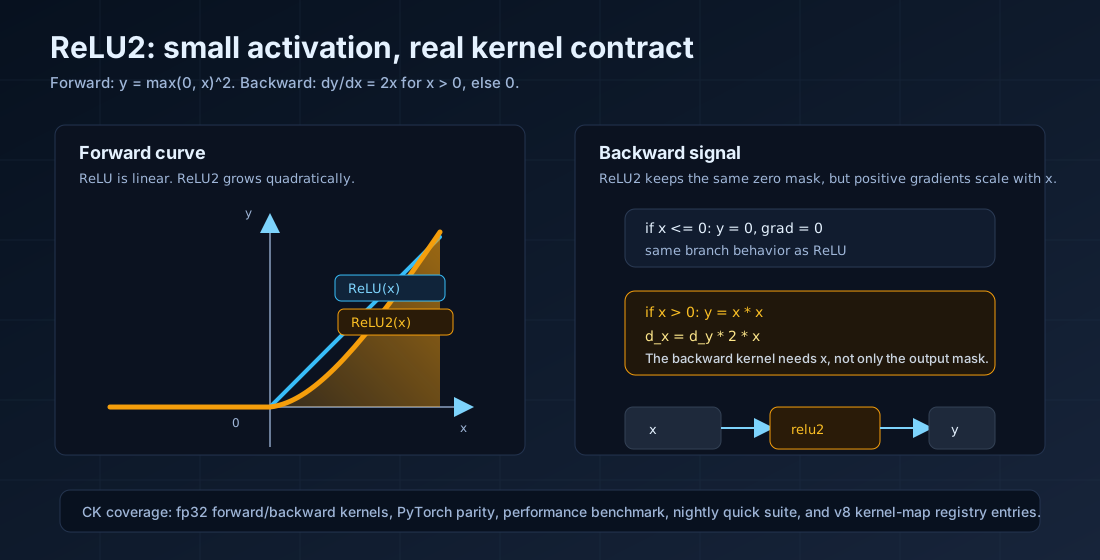
ReLU and ReLU2
ReLU(x)  = max(0, x)
ReLU2(x) = max(0, x)^2

d ReLU2 / dx = 2x if x > 0 else 0
ReLU2 keeps the same negative-value mask as ReLU, but positive activations grow quadratically. The backward kernel must use the original input value, not only a binary mask.
Why CK Has a Dedicated Kernel
It is small math, but it appears across large MLP tensors where memory traffic and branch handling matter. A dedicated forward/backward pair lets CK validate exact PyTorch parity and benchmark the CPU path directly.
relu2_forward_fp32for activation outputrelu2_backward_fp32for gradient propagationmake test-relu2andmake test-relu2-perffor coverage
GELU (GPT-2, BERT)
GELU(x) = x * Φ(x)
        ≈ x * sigmoid(1.702 * x)
Smooth approximation of ReLU that allows small negative values.
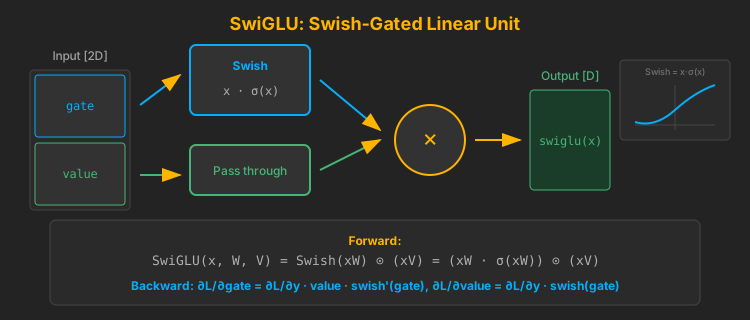
SwiGLU (Llama, Mistral)
Swish(x) = x * sigmoid(x)

SwiGLU(x) = Swish(x @ W_gate) * (x @ W_up)
Gated: One path controls how much of the other passes through.
2x parameters in MLP, but better performance per FLOP.
GeGLU (Gemma, T5 variants)
Split input: x = [a | b]

GeGLU(x) = GELU(a) * b
GELU(a) = 0.5 * a * (1 + tanh(sqrt(2/pi) * (a + 0.044715 * a^3)))
GeGLU replaces the sigmoid/Swish gate with GELU, giving smoother gradients and better calibration for some model families.
Why Gating Works
The gate learns to selectively activate different features:
gate = activation(x @ W_gate)  # Swish (SwiGLU) or GELU (GeGLU)
value = x @ W_up            # The actual content

output = gate * value       # Gate controls information flow
This gives the network more expressive power: it can learn to completely shut off certain dimensions for certain inputs.
Vision Patch Embedding
Multimodal families (Qwen3-VL, Gemma4 Vision, the standalone SigLIP ViT tower) start by turning a raw image into a sequence of encoder tokens. There is no attention or MLP here yet — this is the frontend that the transformer body consumes. In CK-Engine these steps are concrete kernels in src/kernels/vision_kernels.c, not hidden preprocessing, which is what lets the vision encoder share the same lowering and memory plan as the text decoder.
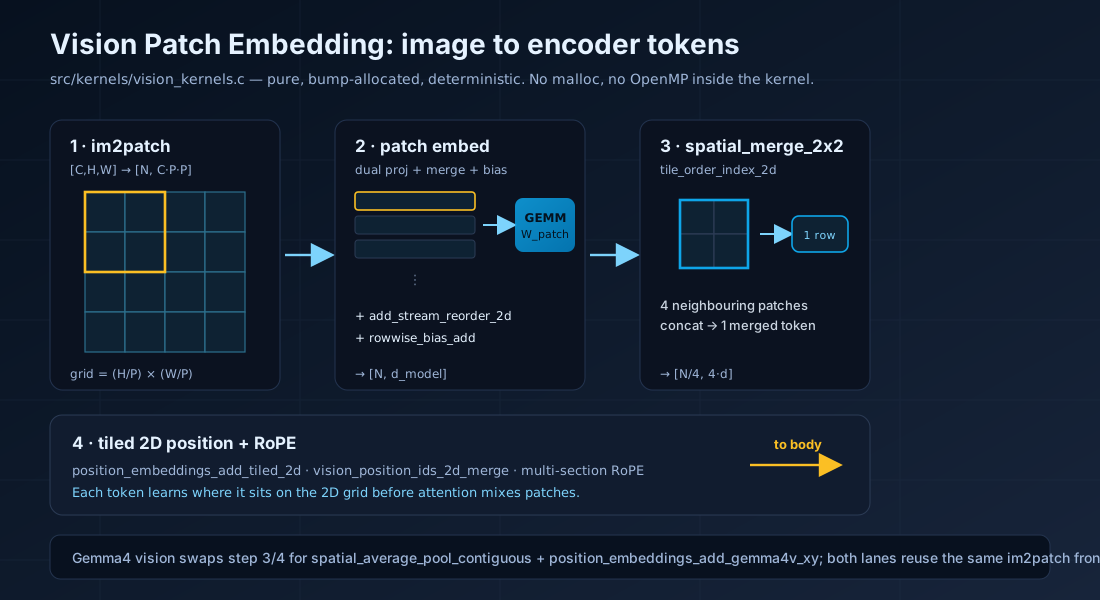
The Frontend Contract
im2patch:        [C,H,W] -> [N, C*P*P]    (N = (H/P)*(W/P))
patch embed:     [N, C*P*P] -> [N, d]     (dual proj + stream merge + bias)
spatial_merge_2x2: group 4 patches -> [N/4, 4*d]
+ tiled 2D pos:  position_embeddings_add_tiled_2d + 2D RoPE
Each patch is a P×P tile across all channels, flattened into one row. spatial_merge_2x2 then groups a 2×2 block of patches into a single token using tile_order_index_2d, which is why the encoder works on a coarser grid than the raw patch grid.
Why Depthwise / Why Strided
im2patch reads strided pixel rows directly rather than materializing reshaped copies, keeping the frontend allocation-free. The same kernels serve two merge policies:
- Qwen3-VL:
spatial_merge_2x2+position_embeddings_add_tiled_2d - Gemma4 Vision:
spatial_average_pool_contiguous+position_embeddings_add_gemma4v_xy - Deepstack:
feature_concatstitches selected layer taps before the projector footer
Current CK Coverage
The patch frontend is validated as part of the v8 Qwen3-VL encoder parity path. The remaining flagged item is the layout memcpy in im2patch (one row copy per patch row) tracked in KERNEL_STATUS.md for conversion to fully strided access. See the v8 Vision Encoder page for the full encoder → bridge → decoder pipeline.
How a Patch Knows Where It Is: 1D Text vs 2D Vision RoPE
Your intuition is exactly right. In text, a token's "position" is a single number — its index t in the sequence (0, 1, 2, …). RoPE turns that index into a rotation angle and rotates every (xi, xi+d/2) dimension pair of Q and K by it. Because rotation is relative, attention automatically recovers "how many tokens apart" two positions are. Position lives on one line.
An image patch has no single index that means anything — what matters is where on the grid it sits. So instead of one scalar, a patch token carries two coordinates: its row y and its column x on the patch grid (the grid being (H/P) × (W/P)). This is the "context is basically the row and the height/column of the i-th patch" idea you described.
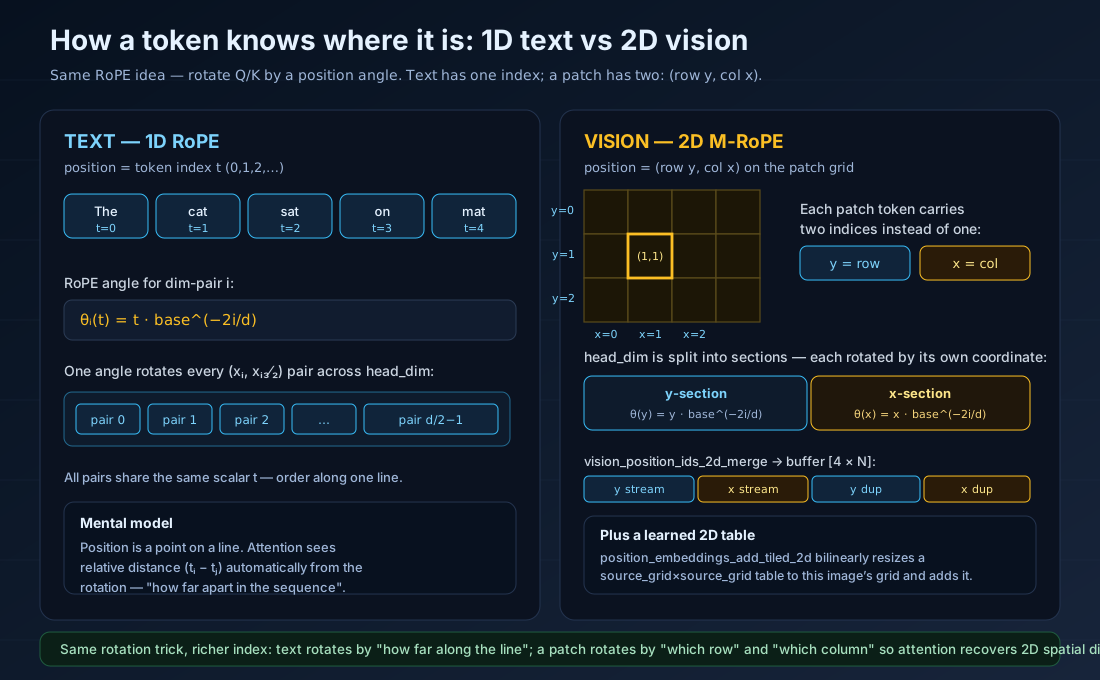
CK encodes this two ways at once, both grounded in src/kernels/vision_kernels.c:
1. Multi-section (M-)RoPE — the rotation path
It is the same RoPE math, just applied to two indices. The head dimension is split into sections: one slice of dims is rotated by an angle derived from the row θ(y), another slice by an angle derived from the column θ(x).
text   :  angle = t * base^(-2i/d)          // one index
vision :  y-dims rotate by  y * base^(-2i/d)
          x-dims rotate by  x * base^(-2i/d) // two indices
vision_position_ids_2d_merge builds the position buffer as four flattened streams [y | x | y | x], emitted in the same 2×2 merged-tile order the patches use, so a token's coordinates line up with its embedding row. After rotation, attention can recover both vertical and horizontal distance between patches — true 2D relative position.
2. Learned 2D position table — the additive path
On top of (or instead of) rotation, vision encoders also keep a learned position embedding table indexed by grid cell — the direct analogue of GPT-2's learned 1D positional embedding, but 2D.
position_embeddings_add_tiled_2d takes a table trained at a fixed source_grid × source_grid resolution and bilinearly interpolates it to whatever grid the current image actually produced, then adds it row-by-row. That is what lets one trained table serve images of different sizes.
Gemma4 vision uses the XY variant position_embeddings_add_gemma4v_xy, which adds separate per-row and per-column components instead of a single interpolated grid.
Text RoPE answers “how far along the sequence?” with one index. Vision M-RoPE answers “which row and which column?” with two — same rotation trick, applied to a 2D grid coordinate, with an interpolatable learned table layered on top.
Audio Frontend: WAV to Log-Mel to Conv Stem
Audio families (Whisper Tiny today) start by turning a raw waveform into a sequence of encoder tokens — the same role the patch frontend plays for vision. In CK-Engine these steps are concrete kernels in src/kernels/audio_kernels.c (declared in include/ckernel_audio.h), not hidden preprocessing, which is what lets the audio encoder share the same lowering, memory plan, and parity-gate machinery as the text and vision lanes.
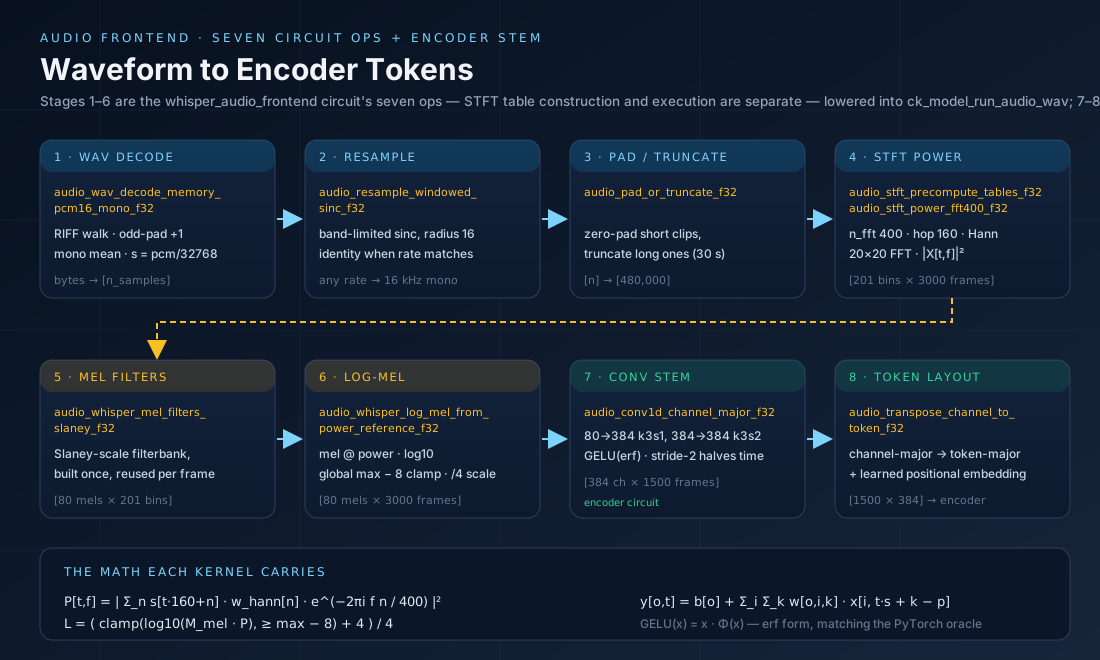
The Frontend Contract
wav decode:  PCM16 -> f32, s=pcm/32768  [n_samples]
resample:    windowed sinc -> 16 kHz mono
pad/trunc:   extent -> 480,000 samples  (30 s)
stft power:  n_fft=400, hop=160, Hann   [201 x 3000]
mel filters: Slaney 80 x 201, built once
log-mel:     log10, clamp max-8, /4     [80 x 3000]
conv stem:   k3s1 + k3s2 + GELU         [384 x 1500]
transpose:   channel -> token major     [1500 x 384]
The stride-2 second convolution halves the time axis, so 3000 log-Mel frames become the 1500 audio tokens the encoder body and the decoder's cross-attention both key on. The learned positional embedding is added after the transpose, directly analogous to the vision table — but 1D along time.
Why These Kernel Choices
- Resampling is explicit:
audio_resample_windowed_sinc_f32is the band-limited path;audio_resample_linear_f32is the fast path — the contract names which one a run used. - STFT is table-driven:
audio_stft_precompute_tables_f32builds the Hann window and trig tables once;audio_stft_power_fft400_f32specializes the Whisper geometry (n_fft=400, hop=160) with a 20×20 mixed-radix FFT instead of a naive DFT. - Channel-major conv:
audio_conv1d_channel_major_f32keeps the stem in the layout the weights arrive in, andaudio_transpose_channel_to_token_f32is the single, named layout seam before attention.
Kernel by Kernel: What Each Stage Actually Computes
Each box in the frontend diagram is a named kernel with a hand-checkable contract. The eight subsections below walk the math exactly as src/kernels/audio_kernels.c implements it — the same deep-dive treatment the other pages give attention and MLP. The full per-kernel deep dive, with inline SVGs and parity-gate evidence, lives on the Audio Kernels Deep Dive page.
1. WAV Decode: RIFF Chunks to Normalized Mono
audio_wav_decode_memory_pcm16_mono_f32 walks the RIFF container by hand: chunk sizes are odd-padded (+1), only the first fmt and data chunks are honored, and anything that is not PCM tag 1 / 16-bit is a typed rejection — there is no silent coercion. The sample conversion is channel-averaged, little-endian, scaled into [−1, 1):
mono[f] = (Σc int16_le( pcm[(f·C + c)·2] ) / C) · (1/32768)
For already-decoded interleaved PCM, audio_pcm_s16_to_mono_f32 applies the same math without the container walk. Deep dive →
2. Resample: Endpoint-Preserving Length, Two Interpolants
The output length is computed to preserve both endpoints — so a 30.00 s clip maps to exactly 480,000 samples at 16 kHz regardless of input rate:
n_out = 1 + (n_in − 1) · r_out / r_in
linear:  y[i] = fmaf(x[r+1] − x[l], frac, x[l])   (integer position math)
sinc:    w(d) = cutoff · sinc(cutoff·d) · hann(d/radius)
         y[i] = Σ w·x / Σ w                    (double position math)
The windowed-sinc path uses cutoff = min(1, r_out / r_in) as its anti-alias guard and clamps radius to [2, 128]; it is the band-limited contract path, while linear interpolation is the declared fast path. Deep dive →
3. Pad / Truncate: The Fixed 30-Second Extent
Everything downstream assumes a fixed time extent — the STFT frame count, the positional table, and the 1500-token cross-attention bridge all derive from exactly 480,000 samples. audio_pad_or_truncate_f32 makes that true for arbitrary input:
copied = min(n_in, 480000)
out[:copied] = in[:copied]   (memmove, overlap-safe)
out[copied:] = 0             (zero-pad short clips)
Short clips are zero-padded, long clips are truncated — not chunked — and the return value reports how many frames were real. Deep dive →
4. STFT Power: 20×20 Mixed-Radix FFT
Frames are center-padded (reflect) and windowed with a periodic Hann, then transformed by an FFT specialized to n_fft=400 — decomposed as 20×20 rather than padded to a power of two:
frame:   x[t·160 + n − 200]   reflect-padded (center = true)
window:  w[n] = 0.5 − 0.5·cos(2πn/400)
FFT:     400 = 20×20  (stage 1: DFT over x[p + 20q],
                        stage 2: combine with twiddle(f, p))
power:   P[t, f] = fmaf(re, re, im·im)   → [201 × T],  T = n/160
Trig tables and the window are built once by audio_stft_precompute_tables_f32; the power accumulation is FMA-fused so the magnitude-squared costs one pass. Deep dive →
5. Mel Filters: The Slaney Filterbank, Built Once
The 80×201 filterbank is constructed once, in double precision, by audio_whisper_mel_filters_slaney_f32 — evenly spaced on the Slaney mel scale, area-normalized so loudness sums comparably across bands:
mel points: n_mels + 2 evenly spaced, mel(0) .. mel(Nyquist)
w[m, bin] = max(0, min(lower, upper)) · 2/(right − left)
Promoting the filterbank to its own circuit op makes the Slaney identity a named, parity-gated artifact; log-Mel receives the matrix as data, the way PyTorch passes a buffer. Deep dive →
6. Log-Mel: Global 80 dB Clamp, Not Per-Frame
The mel projection is a plain matmul against precomputed Slaney-style filters, then the Whisper normalization — note the clamp is against the global max over the whole spectrogram, which is what keeps quiet passages quiet instead of normalizing every frame to full scale:
M  = mel_filters[80 × 201] @ power[201 × T]     (mel-major out)
L0 = log10(max(M, 1e-10))
L  = (max(L0, global_max − 8) + 4) / 4
Result: [80 × 3000] log-Mel features in roughly [−1.5, 0]. Deep dive →
7. Conv1D Stem: Two Strided Convolutions with GELU
The stem stays in the channel-major layout the weights arrive in. Conv1 lifts 80→384 channels (k3, s1, p1), conv2 keeps 384→384 but strides by 2 — that stride is what halves 3000 log-Mel frames into the 1500 encoder tokens:
y[o, t] = b[o] + Σi Σk w[o,i,k] · x[i, t·s + k − p]
conv1: 80 → 384, k3 s1 p1, GELU(erf)   [384 × 3000]
conv2: 384 → 384, k3 s2 p1, GELU(erf)  [384 × 1500]
Accumulation is FMA-fused and the padding is an explicit bounds check (zero-pad), so the kernel has no halo assumptions. Deep dive →
8. Transpose: The Single Named Layout Seam
Attention wants token-major rows; the conv stem produces channel-major. Rather than threading layout flags through every consumer, the frontend does one explicit transpose and names it:
out[t·C + c] = in[c·T + t]     [384 × 1500] → [1500 × 384]
row t = token t + learned 1D positional embedding
After this seam, the audio encoder is layout-identical to the text and vision lanes — the same attention and MLP kernels consume it without a Whisper-specific branch. Deep dive →
Cross-Attention: Decoder Queries, Encoder Memory
Everything above feeds a standard self-attention encoder. The genuinely new piece an encoder–decoder audio model adds is cross-attention: the decoder's queries read keys and values projected from the encoder's 1500 frames, not from its own sequence. That is the bridge every transcribed word is conditioned on — and it is exactly where the runbook's stage-split probe (encoder.npy handoff) cuts the system in two.
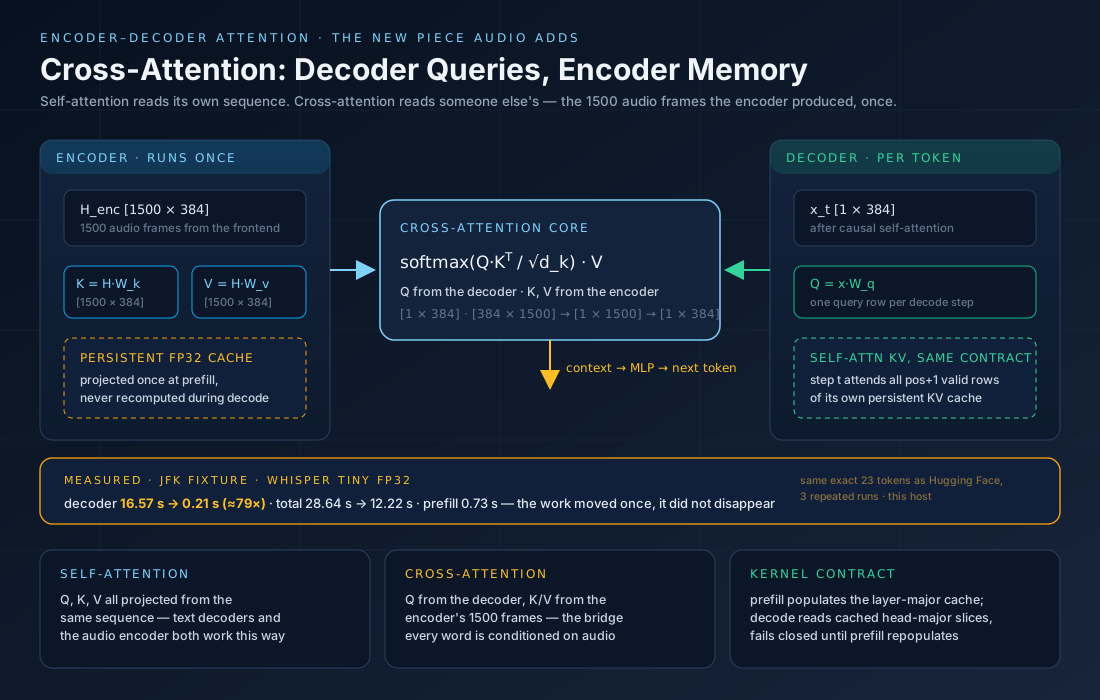
The Math
self-attn:   Q,K,V = xW_q, xW_k, xW_v   (same sequence)
cross-attn:  Q = xW_q                   (decoder, per token)
             K,V = H_enc W_k, H_enc W_v (encoder, once)

attn = softmax(Q K^T / sqrt(d_k)) V
     [1 x 384] x [384 x 1500] -> [1 x 1500] -> [1 x 384]
Because H_enc never changes during decoding, the cross K/V are projected once at prefill and held in a persistent FP32 cache — the decode loop only pays for one new query row per token.
The Kernel Contract
- Prefill: batched causal self-attention over the forced decoder prefix, with a persistent KV-cache transition oracle.
- Decode step t: self-attention attends all
pos+1valid rows of its own cache; cross-attention attends all 1500 encoder rows (theQ=1, K=1500oracle). - Same primitives, new wiring: the attention math is the one from Attention Mechanisms; only the provenance of K and V changes, which is why codegen needs no Whisper-specific branch.
Current CK Coverage
Nightly validates the log-Mel frontend against PyTorch, the audio transformer primitives (resampling, FFT, Conv1D, GELU, layout transforms, self-attention, cross-attention), and the portable v8 audio circuit/codegen regression. Scheduled CI also runs a non-skippable five-minute MIC1 corpus through the declared Whisper size matrix, checking transcript quality, complete window progress, bounded timestamps, and generated-runtime evidence. The short JFK artifact gate remains the token-exact oracle. See Whisper Tiny End-to-End for the pipeline diagram and evidence, the v8 Runbook for the operator commands, and the Audio Kernels Deep Dive for the per-kernel math of every stage above.
Newer audio families extend the same kernel vocabulary beyond the Whisper frontend. The deep dive continues with Transformer-XL relative attention (position as a tensor, not a table), the FastConformer convolution module (pointwise → GLU → depthwise → BatchNorm → SiLU), the LSTM prediction step behind transducer decoding, and a Whisper/Parakeet/Cohere log-mel contract comparison; the TDT token-and-duration state machine is drawn on the Parakeet page.
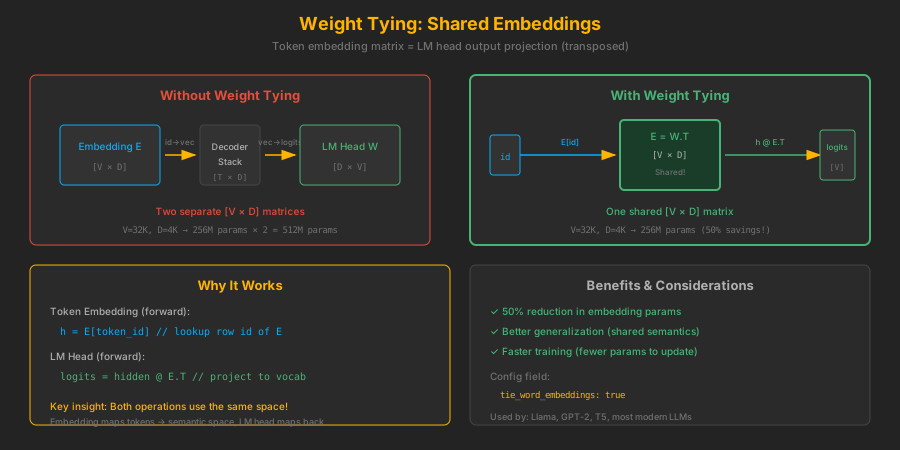
Weight Tying
Weight tying shares parameters between the input embedding and output projection, reducing model size with minimal quality loss.
What Gets Shared
Input embedding:  token_id → vector    E[vocab, hidden]
Output projection: vector → logits     W[vocab, hidden]

With weight tying: W = E  (same matrix!)
Savings: For vocab=128K, hidden=4096: saves 2 GB of parameters
Why It Works
Intuition: The embedding and LM head learn similar things:
- Embedding: "What vector represents this token?"
- LM Head: "Which token does this vector represent?"
These are inverse operations, so sharing makes sense semantically.
Gradient implication: During training, gradients from both the embedding lookup and the LM head accumulate into the same weight matrix.
Hyper-Connections (Multi-Stream Residuals)
Qwen3.8 Flash Next (PR #456) replaces the single residual stream with S parallel hyper-streams: the hidden state is broadcast from [R, D] to [R, S*D] at layer entry, and each block writes back into selected streams instead of one shared residual. CK implements this as residual_topology: four_stream_gated_hyper_connection in the qwen4_exp circuit.
The Kernel Family
hyper_stream_expand_f32/_bf16— broadcast hidden[R,D]into S streams[R,S*D].hyper_connection_mix_bf16— per-stream RMSNorm, then a low-rank dynamic mix (dyn = norm * W_down,mix = dyn * W_up) combining static and dynamic stream mixing with optional injection logits. Quantized variants:hyper_connection_mix_q4k_q5_0_q4kand_q6k_q5_0_q4k.hyper_stream_inject_bf16/_f32— add the block output back into selected streams.hyper_connection_final_mix_*— collapse streams back to one hidden state.
Source: src/kernels/hyper_connection_kernels.c.
Why Multi-Stream Residuals Help
A single residual stream forces every block to read and write the same D-wide accumulator. Hyper-connections widen the residual bandwidth — information can route around a block on a stream the block does not touch — without widening every GEMM and attention op. The cost is a small low-rank mixing matrix per layer instead of a full D x D projection.
For the runtime this is a scheduling contract: stream ownership, mix order, and injection targets are declared per layer, and the quantized mix variants exist so the residual path does not silently change precision between circuits.
Certification Status (Qwen3.8 Flash Next)
Certified so far (Q4_K_M): the strict 40-token prompt plus 64 full-vocabulary decode comparisons all pass after the terminal-row fix (2026-09-05), and the follow-up all-layer X-Ray capture reports 45,285 exact comparisons with zero value differences (671 unavailable entries are explicitly not counted). Still open: BF16 certification, the long-context ladder (the 128K run is planner-only — arena sized, not executed), and performance certification. Treat the current status as experimental Q4_K_M execution with short-prompt parity, not certified long-context support. Details: docs/notes/QWEN38_FLASH_NEXT_BRINGUP_2026-09-04.md.
Per-Layer Embedding (PLE)
PLE gives every layer a cheap, token-context-sensitive input without running attention: a rolling n-gram window over recent token states is hashed into per-layer embedding tables, gated, smoothed by a causal conv, and injected into the hyper streams.
N-gram Table Lookup
ring window: last n token states (EOS-padded)
hash n-gram -> per-layer embedding table
embed = table[hash] * layer_multipliers[layer]
Kernels: qwen4_ple_ngram_embed_bf16 and qwen4_ple_ngram_embed_q5_0 (src/kernels/qwen4_exp_kernels.c). The tables are per layer, so the same n-gram contributes a different vector at each depth, scaled by layer_multipliers.
Gated Conv Injection
group-RMSNorm(key/query) -> sigmoid gate
-> dilated causal depthwise conv (persistent conv_state)
-> inject into hyper streams
Kernels: qwen4_ple_gate_conv_inject_bf16, _fp16, _llama_fp16. The conv is causal and dilated with persistent state, so decode updates it incrementally exactly like a recurrent conv state — the same ownership discipline as the DeltaNet and Mamba2 states above.
Summary: What Each Config Field Controls
| Config Field | What It Controls | Typical Values |
|---|---|---|
hidden_size |
Main embedding dimension | 768, 2048, 4096, 8192 |
num_hidden_layers |
Number of transformer blocks | 12, 24, 32, 80 |
num_attention_heads |
Q heads for attention | 12, 32, 64 |
num_key_value_heads |
K,V heads (GQA) | Same as heads, or 8, 4, 1 |
intermediate_size |
MLP hidden dimension | 4x hidden (SwiGLU: 2.67x) |
rope_theta |
RoPE base frequency | 10000, 500000, 1000000 |
sliding_window |
Attention window size (0 = full causal) | 0, 256, 512, 1024 |
rms_norm_eps |
Numerical stability in norm | 1e-5, 1e-6 |
vocab_size |
Vocabulary size | 32000, 50257, 128256 |
max_position_embeddings |
Maximum context length | 2048, 8192, 131072 |
tie_word_embeddings |
Share embed & LM head | true/false |
Further Reading
- Kernel Reference - API documentation for each kernel
- Code Generation - How we generate C from configs
- Source Code - Browse the implementation