Deterministic Memory Layout
Why static memory offsets matter, and what they enable for monitoring, debugging, and mechanistic interpretability.
The Core Insight
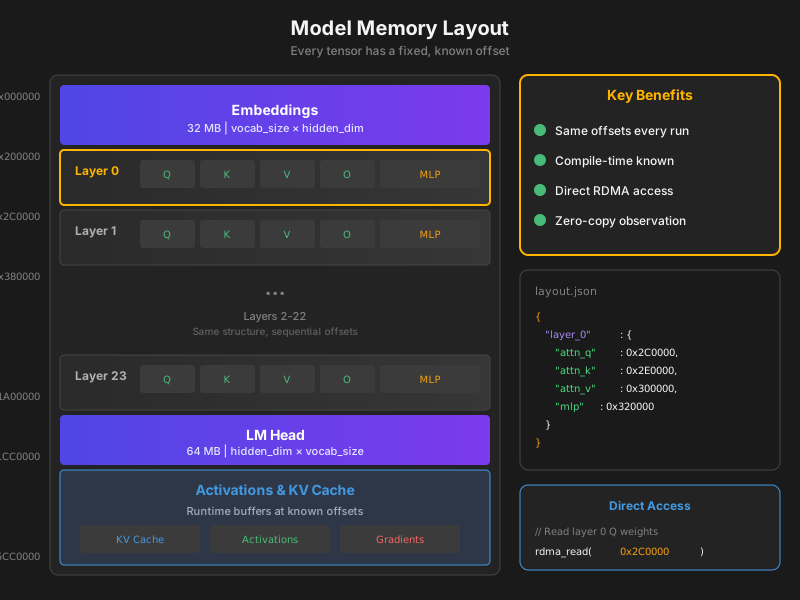
C-Kernel-Engine generates C code with compile-time known memory offsets. Every tensor, every weight, every activation has a fixed address that never changes between runs.
This isn't just an implementation detail—it's a fundamental architectural choice that unlocks capabilities impossible in dynamic frameworks like PyTorch or JAX.
Why Deterministic Memory?
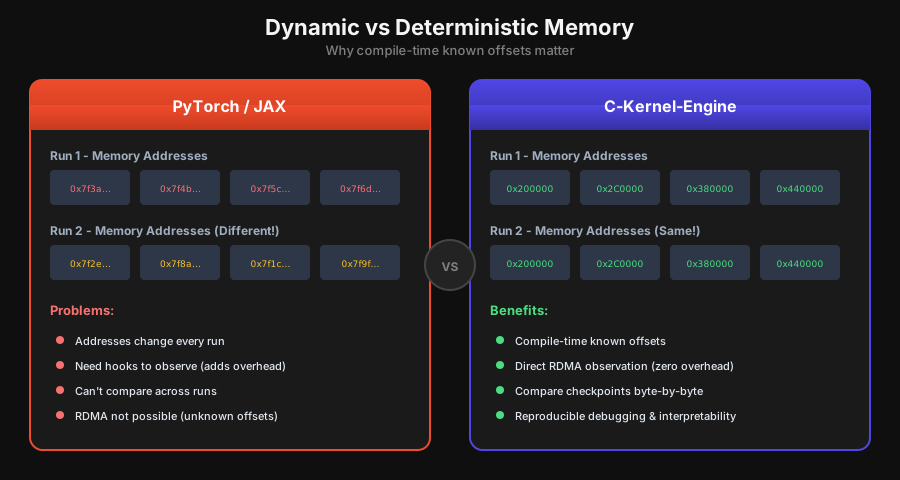
Dynamic Frameworks (PyTorch)
- Memory allocated at runtime
- Addresses change every run
- Need hooks to observe tensors
- Hooks add overhead to training
- Can't observe without perturbing
C-Kernel-Engine
- Memory layout computed at compile time
- Same offsets every run
- Direct memory access via RDMA
- Zero overhead observation
- Observe without disturbing compute
The Layout JSON: Your Memory Address Book
When you generate code with build_ir_v4.py, you also get a layout.json
that maps every tensor to its exact memory location:
{
  "model": "Qwen2-0.5B",
  "layers": {
    "layer_15": {
      "attn_q": {"offset": "0x0A2400", "size": 1605632, "dtype": "bf16"},
      "attn_k": {"offset": "0x0A4800", "size": 1605632, "dtype": "bf16"},
      "attn_v": {"offset": "0x0A6C00", "size": 1605632, "dtype": "bf16"},
      "mlp_gate": {"offset": "0x0B2000", "size": 3211264, "dtype": "q4_k"}
    }
  }
}
This "address book" is the key to everything that follows. You can point to any tensor by name and know exactly where it lives in memory.
What This Enables
1. Zero-Overhead RDMA Monitoring
RDMA (Remote Direct Memory Access) supports one-sided operations. An observer can read memory from compute nodes without those nodes even knowing it happened—no interrupts, no CPU involvement, no overhead on training.
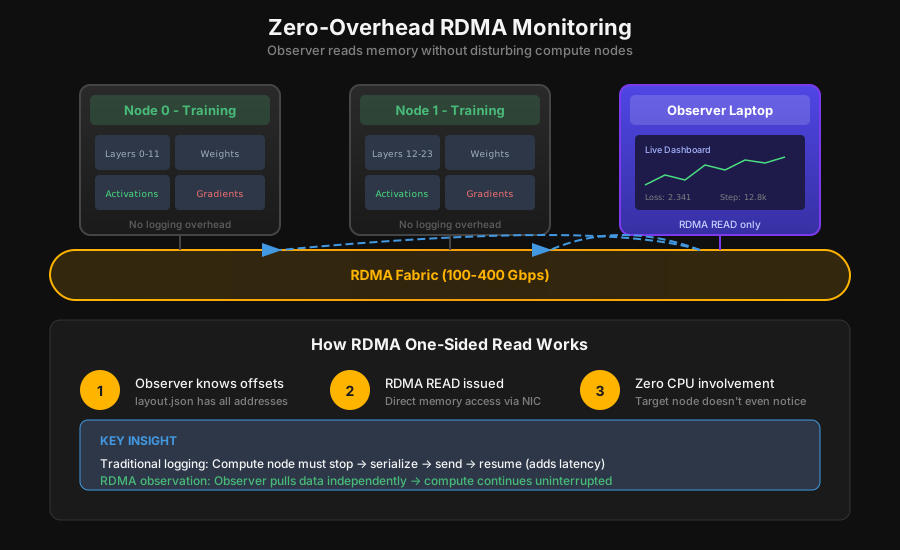
The observer laptop can sample any tensor at any rate (1Hz, 10Hz, 100Hz) without affecting training throughput. Traditional logging requires compute nodes to serialize and send data—that's overhead you can't avoid.
2. Live Tensor Inspector
┌─────────────────────────────────────────────────────────┐
│ Layer 15 Attention                                      │
├─────────────────────────────────────────────────────────┤
│ Q [0x0A2400 - 0x0A4800]  896×896 bf16  ████████░░ 2.1ms │
│ K [0x0A4800 - 0x0A6C00]  896×896 bf16  ██████████ 1.8ms │
│ V [0x0A6C00 - 0x0A9000]  896×896 bf16  ███░░░░░░░ 0.4ms │
│ Scores [0x0A9000]        896×896 f32   computing...     │
└─────────────────────────────────────────────────────────┘
Click any tensor to see values, histograms, NaN detection. Because memory layout is static, these offsets work across runs—you can compare the same tensor position across different training experiments.
3. Pipeline Parallel Visualization
Node 0 (Layers 0-7)    Node 1 (Layers 8-15)   Node 2 (Layers 16-23)
┌──────────────────┐   ┌──────────────────┐   ┌──────────────────┐
│ █ Micro-batch 0  │──▶│ █ Micro-batch 0  │──▶│ ░ waiting        │
│ █ Micro-batch 1  │   │ ░ Micro-batch 1  │   │                  │
│ ░ Micro-batch 2  │   │                  │   │                  │
└──────────────────┘   └──────────────────┘   └──────────────────┘
  RDMA: 12.4 GB/s        RDMA: 11.8 GB/s
For distributed training, you know exactly which bytes transfer between nodes. Track pipeline bubble efficiency in real-time without any instrumentation overhead.
4. Checkpoint Diff Tool
ck-diff checkpoint_step1000.bump checkpoint_step2000.bump

Layer 15 MLP Gate [0x0B2000]:
  Step 1000: mean=-0.0012, std=0.0234
  Step 2000: mean=-0.0018, std=0.0241
  Delta:     mean=-0.0006, std=+0.0007  ✓ healthy

Layer 23 Output [0x2A0000]:
  WARNING: std increased 3x - possible gradient explosion
Compare checkpoints byte-by-byte. Because layout is deterministic, offset 0x0B2000 means the same thing in both files.
5. Deterministic Replay Debugging
Since memory layout is static:
- Record input tokens + random seeds
- Replay exact same forward pass
- Step through layer-by-layer with known offsets
- Compare across runs (impossible in PyTorch where allocations differ)
Mechanistic Interpretability
This is where deterministic memory becomes transformative. Mechanistic interpretability research aims to understand how neural networks actually work internally. The field struggles because frameworks hide everything behind abstractions.
The Interpretability Unlock
| Traditional Approach | With C-Kernel-Engine |
|---|---|
| "What's attention head 7 doing?" → Add hooks, slow down training |
layer_15_head_7 @ 0x0A2400→ RDMA read, zero overhead |
| "Patch this activation" → Framework gymnastics |
memcpy(0x0A2400, patch, size)→ Direct memory write |
| "Trace information flow" → Black box |
Follow the offsets in layout.json → Explicit dataflow graph |
Live Circuit Discovery
# While training is running, observe attention patterns
for layer in range(24):
    for head in range(14):
        attn = rdma_read(f"layer_{layer}_head_{head}_scores")
        if attn[query_pos, key_pos] > 0.8:
            print(f"Strong connection: L{layer}H{head}")
No hooks. No slowdown. Just read memory.
Activation Patching at Scale
# Causal intervention: "What happens if we zero this head?"
original = rdma_read(node=0, offset=LAYER_15_HEAD_7)
rdma_write(node=0, offset=LAYER_15_HEAD_7, data=zeros)
# Observe effect on output
rdma_write(node=0, offset=LAYER_15_HEAD_7, data=original)  # Restore
Neuron-Level Probing
Layer 15, Neuron 847:
  Activates strongly on: "capital cities", "country names"
  Offset: 0x0B2400 + 847*4
  Historical max: 12.4 (on token "Paris")
  Current: 0.02
Gradient Attribution
"Which weights most affected this prediction?"

∂Loss/∂W for every weight, at known offsets:
  layer_15_mlp_gate[0x0B2000]: 0.0023  ← high attribution
  layer_15_mlp_up[0x0B4000]:   0.0001  ← low
  layer_22_attn_o[0x1A2000]:   0.0089  ← highest!
Mechanistic First Pass (v6.6, Before v7 Training)
A practical first protocol should be small, repeatable, and comparable across models. Use the same prompts, token index, and context length each run.
Protocol Goals
- Verify dataflow is numerically healthy at early layers (L0/L1/L2/L3)
- Capture stable activation snapshots for the same prompt/token across model families
- Localize first divergence point before changing kernels or training code
- Build a baseline archive to compare against v7 training checkpoints
Step 1: Run a Stable Repro Case
# Use one fixed model + prompt + token budget
python3 version/legacy/v6.6/scripts/ck_run_v6_6.py run \
  hf://Qwen/Qwen3-0.6B-GGUF/Qwen3-0.6B-Q8_0.gguf \
  --context-len 1024 --max-tokens 32 --force-compile --force-convert \
  --prompt "Explain why matrix multiplication is associative."
Step 2: Probe Layer-Level Sanity (L0+)
python version/legacy/v6.6/test/test_layer_by_layer.py \
  --model ~/.cache/ck-engine-v6.6/models/Qwen--Qwen3-0.6B-GGUF \
  --token 25
This validates embedding and early-layer weight/normalization integrity without needing full decode analysis.
Step 3: Capture Stop-Point Activations
python version/legacy/v6.6/test/v6_6_comprehensive_debug.py \
  --model-dir ~/.cache/ck-engine-v6.6/models/Qwen--Qwen3-0.6B-GGUF \
  --token 25 --stop-at 5 --threads 1 --context-len 1024
Repeat with increasing --stop-at to walk the pipeline in order
(embedding → norm → q/k/v proj → rope → attention → out_proj).
Step 4: Locate First Divergence
python version/legacy/v6.6/test/trace_divergence.py \
  --model ~/.cache/ck-engine-v6.6/models/Qwen--Qwen3-0.6B-GGUF \
  --token 25 --threads 1 --context-len 1024
Use this to identify the first failing op. That op is your intervention boundary for mechanistic analysis.
Step 5: Use IR Visualizer as the Analysis Surface
python version/legacy/v6.6/tools/open_ir_visualizer.py Qwen--Qwen3-0.6B-GGUF- Interpretability tab: inspect math blocks and generated dump instrumentation.
- Dataflow tab: confirm producer/consumer chain for suspect ops.
- Profile tab: validate hotspot shifts are expected when changing kernels.
Attention Heads: Current and Next
In v6.6, attention is already head-major and GQA-aware in kernel contracts, so head-level analysis is structurally possible. Current workflow is op-level plus tensor dump tracing.
The next concrete improvement is a dedicated head view: per-layer, per-head attention summary for a fixed token position and prompt, loaded directly from dump artifacts. This should become the first panel in v7 interpretability work.
Recommended Baseline Matrix (Before v7)
| Model | Prompt Set | Capture | Purpose |
|---|---|---|---|
| Qwen2-0.5B | 4 fixed prompts | L0-L3 stop-point dumps + divergence report | Legacy-stable baseline |
| Qwen3-0.6B | same prompts | L0-L3 stop-point dumps + divergence report | QK-norm + sliding behavior baseline |
| Gemma3-270M | same prompts | L0-L3 stop-point dumps + divergence report | Template/contract variance baseline |
Comparison with Traditional Approaches
| Capability | Dynamic Framework | C-Kernel-Engine |
|---|---|---|
| Memory layout | Changes every run | Fixed at compile time |
| Observability | Hooks (add overhead) | Direct RDMA read (zero overhead) |
| Activation patching | Slow, framework-specific | Direct memory write |
| Probing classifiers | Offline analysis | Real-time |
| Attention visualization | Post-hoc | Live during training |
| Circuit tracing | Manual, tedious | Automated via layout.json |
| Reproducibility | Difficult (allocation varies) | Guaranteed (same offsets) |
The Observer Architecture
A third machine (laptop, monitoring server) can observe training clusters via RDMA without affecting their performance:
# observer.py - runs on separate machine
class TrainingObserver:
    def __init__(self, nodes, layout_json):
        self.layout = load_layout(layout_json)  # Static offsets!
        self.rdma = RDMAConnection(nodes)

    def sample_gradients(self, layer):
        offset = self.layout[f"layer_{layer}"]["grad_offset"]
        size = self.layout[f"layer_{layer}"]["grad_size"]

        # One-sided read - compute node doesn't notice
        data = self.rdma.read(node=layer // 12, offset=offset, size=size)
        return np.frombuffer(data, dtype=np.float32)

    def check_for_nans(self):
        for layer in range(24):
            grad = self.sample_gradients(layer)
            if np.isnan(grad).any():
                alert(f"NaN detected in layer {layer}!")
The Philosophy
"We can't interpret what we can't see."
Dynamic frameworks hide computation behind layers of abstraction. The memory allocator decides where tensors live. Hooks and callbacks add overhead to observe what's happening.
C-Kernel-Engine takes the opposite approach: everything is explicit. The generated C code shows exactly what computation happens. The layout.json shows exactly where every tensor lives. RDMA lets you observe without disturbing.
This doesn't solve interpretability—the science is still hard. But it removes the infrastructure barriers that make interpretability research difficult. When you can see everything, you can start to understand everything.
Summary
- Deterministic layout → Reproducible experiments, same offsets every run
- Zero-overhead observation → Don't perturb what you measure
- Explicit computation → No hidden framework magic
- Known offsets → Point to any neuron, any layer, any time
- RDMA observer → Separate monitoring from compute