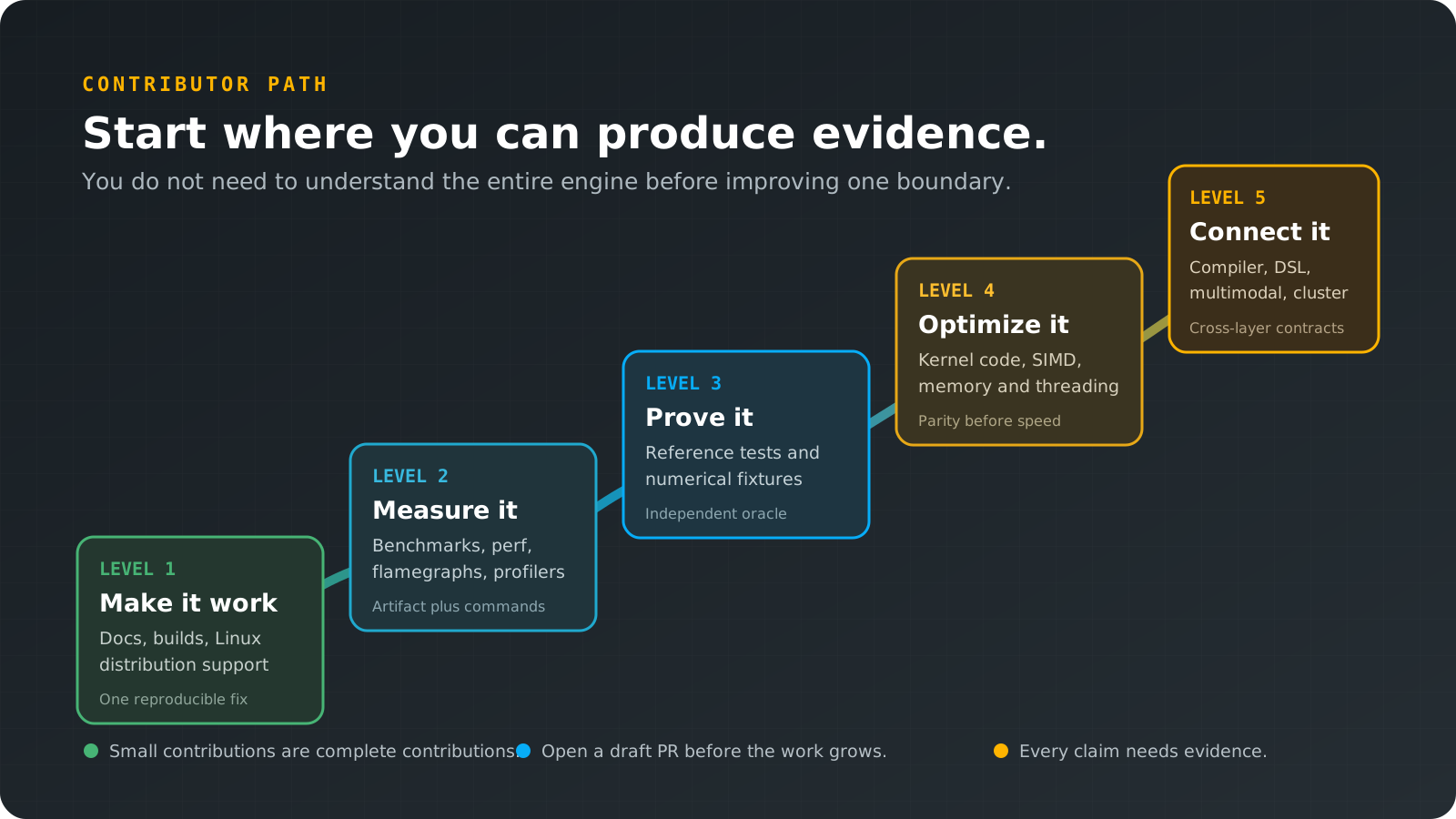
Start small. Learn one boundary. Make it reproducible.
C-Kernel-Engine spans model mathematics, generated C, numerical contracts, SIMD kernels, Linux profiling, multimodal execution, and future distributed CPU systems. You do not need to understand all of it before contributing. Begin with one bounded problem whose result another engineer can reproduce.
The hard research problem is not the entrance exam
Current work may involve Qwen3-VL long-context divergence, BF16 reduction semantics, AVX2/AVX-512/AMX dispatch, compiler ownership, or multimodal parity. Those are Level-5 problems. A distribution fix, profiler adapter, benchmark artifact, documentation correction, or independent numerical fixture is a complete and useful contribution.
Progression is optional, not a ranking. Own the smallest level where you can produce a reliable result.
The Five Contribution Levels
LEVEL 1
Documentation, compatibility, and build fixes
Improve setup instructions, repair one distribution-specific failure, clarify a command, or make an existing workflow reproducible on a named machine.
Completion evidence
Environment details, failing command, corrected command or patch, and proof the documented path now succeeds.
LEVEL 2
Benchmarks and profiling adapters
Add a repeatable perf, FlameGraph, flamegraph-rs, VTune, Advisor, cache, assembly, or power-measurement lane without breaking existing platforms.
Completion evidence
Exact command, CPU and compiler metadata, workload, raw artifact, interpretation, and known sources of measurement noise.
LEVEL 3
Reference tests and numerical fixtures
Exercise one operation or canonical tensor boundary against PyTorch, llama.cpp, SciPy, a finite-difference gradient, or another independent implementation.
Completion evidence
Deterministic fixture, independent oracle, tolerance and dtype policy, failure reproduction, and regression test.
LEVEL 4
Kernel implementation and optimization
Implement or tune one C kernel, SIMD route, memory layout, fusion, quantized path, or thread-pool boundary.
Completion evidence
Parity first, supported-ISA detection, before/after benchmark, profiler attribution, fallback behavior, and no unsupported performance claim.
LEVEL 5
Compiler, DSL, multimodal, and distributed systems
Written contract, cross-layer tests, generated-C inspection, architecture regression coverage, migration impact, and end-to-end evidence.
Three Good First Paths
Linux distribution and profiling adapter
Build one known model on Arch, CachyOS, Fedora, Debian, or another Linux environment. Preserve Ubuntu behavior while adding explicit commands for the platform's profiler package and interface.
Concrete example: detect or document flamegraph-rs on Arch/CachyOS instead of assuming the Perl FlameGraph command line, then capture the resulting SVG and baseline metadata.
Reproducible benchmark artifact
Run one supported model with a fixed prompt and thread count. Record CPU topology, ISA flags, compiler, CKE commit, model hash, command, prompt-eval rate, decode rate, RSS, and profiler output.
The contribution is the reproducible evidence package, not a context-free tokens-per-second number.
One numerical boundary
Choose RMSNorm, RoPE, quantized dot product, softmax, Conv1D, attention, or another bounded operation. Compare CKE against an independent oracle using deterministic tensors and an explicit precision policy.
Do not begin with complete model generation unless the smaller boundary already passes.
Documentation that follows the code
Reproduce a public guide from a clean checkout. Correct stale paths, unsupported assumptions, missing dependencies, or unclear evidence labels. Link every claim to the current implementation or test.
Documentation-only changes still need reproduction evidence.
Finding the right page to update is easier with the built-in site search: press / on any docs page (or Ctrl+K) and search across every published guide, runbook, and section anchor. Search runs fully client-side in the browser against search-index.json, which docs/site/build.sh regenerates on every build, so new or updated pages become searchable as soon as the site is rebuilt.
The Onboarding Loop
Build
Follow the quickstart and record your machine, OS, CPU, compiler, and commit.
Choose one boundary
Use an existing issue or open a focused issue describing one observable failure or missing path.
Reproduce
Capture the failing and passing commands before broadening the change.
Open a draft PR
Share direction early. Do not wait until a large rewrite is complete.
Close with evidence
Attach tests, artifacts, limits, and the exact claim the change supports.
Discord Onboarding
If you are already in the CKE Discord: introduce yourself with your operating system, CPU, compiler, the CKE path you successfully ran, and one contribution level that interests you. Link a focused GitHub issue or draft PR so technical decisions remain searchable outside chat.
If you need an invite: open a short onboarding issue in the CKE repository. The public repository remains the durable source for scope, commands, patches, evidence, and review; Discord is for coordination and questions, not the only copy of a technical decision.
Good first message: "I built commit <sha> on <OS> with <CPU/compiler>. I want to work at Level 2 on the Arch/CachyOS flamegraph-rs path. Here is my baseline command and draft issue."
Pull Request Evidence Contract
Include
Why it matters
Problem and bounded scope
Reviewers can tell what changed and what deliberately did not.
Hardware, OS, compiler, model, and commit
CPU behavior and performance claims are environment-dependent.
Exact reproduction commands
Another contributor can rerun the result without reconstructing your shell history.
Independent correctness evidence
An implementation must not validate only against itself.
Before/after artifacts for performance work
Optimization requires attribution, not intuition or CPU utilization alone.
Known limits and unsupported cases
A narrow validated path must not become a broad accidental claim.
Focused commit history
Intent remains inspectable and unrelated changes do not hide in the patch.
The configured path should be .githooks. Run the tests relevant to your changed boundary and report exactly what ran. Do not claim the complete engine passed if you ran only a scoped test.
make
make test

# Examples of focused Python gates
python3 -m pytest tests/test_v8_attention_contracts.py
python3 -m pytest tests/test_v8_numerical_execution_contracts.py
AI assistance does not transfer responsibility
AI tools may help inspect code, propose tests, or draft a patch. The human contributor remains accountable for every equation, hardware assumption, generated artifact, claim, and line submitted, and represents that they have the right to submit the material for project review. AI providers are not listed as contributors merely because their tools were used. Correct-looking code without independent evidence is not a completed contribution.
Contribution, Recognition, Copyright, And Licence Are Different
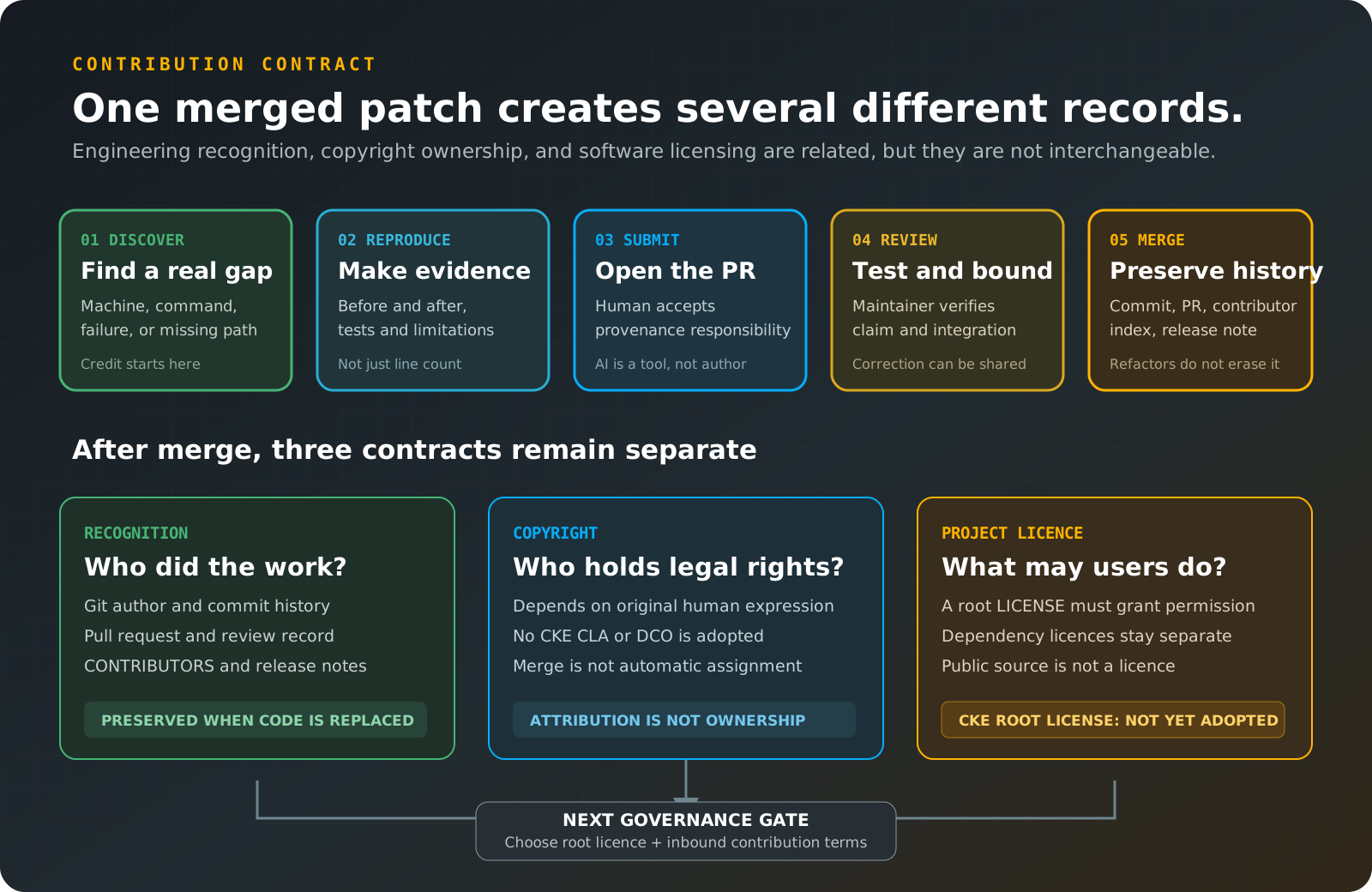
A contribution is the engineering act of finding a bounded problem, reproducing it, submitting a correction with evidence, and passing review. Recognition records who performed that work. Copyright concerns legal rights in original expression. A software licence states what permissions a rights holder grants to users. Merging one pull request does not collapse those four concepts into one.
A merge preserves engineering history. It does not silently create a copyright assignment or a project-wide software licence.
Engineering contribution
The person found or clarified a real boundary, produced reproducible evidence, and submitted a reviewed improvement. This can be meaningful even when the final patch is small.
Recognition
Git commits, pull requests, CONTRIBUTORS.md, .mailmap, and release notes preserve who did the work. Recognition survives later refactoring.
Copyright
Copyright, where it exists, concerns original human expression. CKE currently has no CLA or DCO, so a merge is not documented as an automatic copyright assignment.
Software licence
A root licence grants reuse permissions for the project. Dependency licences apply to those dependencies only; they do not automatically license CKE's original code.
Current CKE licensing status
CKE does not currently publish a root LICENSE file. Repository visibility is not the same as an open-source licence. Until explicit terms are adopted, do not infer a general grant to copy, modify, redistribute, sublicense, or sell CKE code from the licences of llama.cpp, PyTorch, or any other included project.
Read LICENSING.md for the current boundary and the governance steps required before a stable licensed release.
Recognition Survives Refactoring
CKE recognizes the person who found the problem, established the reproduction, and submitted the reviewed correction. Recognition is not measured only by line count, and replacing those lines later does not erase the original engineering contribution.
Merged commits and pull requests remain the authoritative historical record.