C-Kernel-Engine
A CPU-native AI runtime and kernel compiler for auditable inference, training kernels, and distributed CPU execution. Python tooling imports models, builds the IR, generates C, and runs parity checks; the execution path is C-first and compiled with the best native CPU toolchain available.
Why this exists: build lightweight AI systems without sacrificing performance or auditability, keep the full stack visible end-to-end (model import -> IR -> memory layout -> generated C kernels), and scale CPU-first across embedded devices, commodity servers, and owned CPU clusters.
Get Started
v8 is the current inference runtime. One wrapper command converts a model to weights.bump, lowers its circuit, generates and compiles the C runtime, and runs it on a plain Linux CPU. Start with a small model, then pick your family in the runbook.
Run your first model — Gemma 3 270M (v8)
git clone https://github.com/C-Kernel-Engine/C-Kernel-Engine.git
cd C-Kernel-Engine
python3 -m venv .venv && . .venv/bin/activate
python -m pip install -r version/v8/requirements.txt

version/v8/scripts/cks-v8-run run \
  hf://unsloth/gemma-3-270m-it-GGUF/gemma-3-270m-it-Q5_K_M.gguf \
  --context-len 1024 --force-compile --force-convert --chat-template=auto \
  --generate-visualizer
The first run is cold: it downloads the GGUF, converts weights, generates C, and compiles it; later runs reuse the artifact and start warm. --generate-visualizer opens the IR visualizer so you can inspect every operation, selected provider, and memory offset of the run you just produced.
v8 Runbook — every model family → Kokoro TTS bring-up → Full Quickstart → Model Support Matrix →
Verify the kernel library
make                  # builds build/libckernel_engine.so
make test             # kernel parity tests vs PyTorch
Each kernel ships its own Python ctypes parity test with a hard max-diff < 1e-5 gate. AVX2 is the x86 production baseline; ARM NEON is an active portability lane; AVX-512, VNNI, BF16, and AMX paths enable only where the host supports them.
Where to go next
| Concepts | How circuits, kernel maps, and generated C fit together. |
| X-Ray | Inspect a run: selected providers, rejection reasons, per-op evidence. |
| Kernel maps | Bring up a new model family or provider. |
| Bring a model to CKE | Contributor tutorial: math to standalone C, with the executable Qwen2 spine. |
| Audio deep dive | Speech kernels from WAV to transcript, visually explained. |
Inference — Generate C Runtime
make ck-emit \
  CONFIG=path/to/config.json \
  OUT=build/generated_model.c
Emits a complete C file from IR. Load GGUF quantized weights via make gguf-convert.
Training — v7 IR Runtime
. .venv/bin/activate
python version/v7/scripts/ck_run_v7.py init \
  --run /tmp/myrun \
  --template qwen3 \
  --generate-ir --generate-runtime --strict
python version/v7/scripts/ck_run_v7.py train \
  --run /tmp/myrun \
  --backend ck --parity-on
Produces IR1, IR2, layout, generated C runtime, and parity artifacts.
How CKE Works
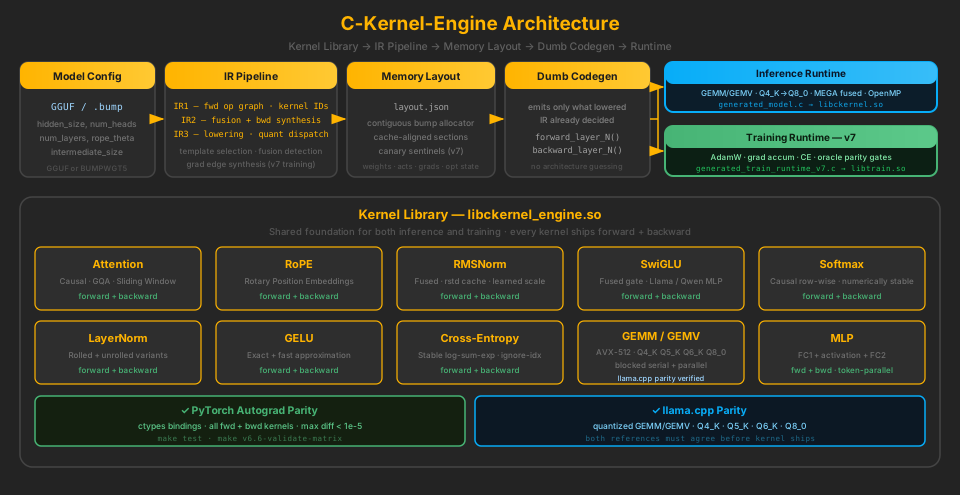
C-Kernel-Engine is split into two layers. The tooling layer uses Python for model import, GGUF/safetensors conversion, IR construction, code generation, and PyTorch/llama.cpp parity testing. The execution layer is generated C plus hand-written C kernels with explicit memory offsets, quantization layouts, SIMD dispatch, and native compiler optimization.
Both inference and training share the same IR foundation. The inference path (v8) adds quantized dispatch, model-family contracts, multimodal coverage, and runtime profiling hooks. The training path (v7) adds backward synthesis, explicit gradient accumulation, and a separate training memory layout — built on top of the same IR1/IR2 lowering chain.
Q4_0 · Q4_K · Q5_K · Q6_K · Q8_0 · BF16 · FP32
→ layout.json
no architecture guessing in the emitter
GEMM / GEMV quantized dispatch
MEGA fused kernels (prefill + decode)
OpenMP thread pool
accumulation windows → ir2_train_backward.json
canary sentinels between sections → layout_train.json
canary write + verify by phase
AdamW · grad accumulation windows
cross-entropy (stable log-sum-exp)
PyTorch oracle parity gates
The kernel library is the shared foundation for both pipelines — every kernel used in inference is also the backward-pass primitive used in training:
Deep Dives — See How Real Models Run
Featured Deep Dive: Gated DeltaNet
Qwen3.5/qwen3next-style recurrent attention uses a compact state matrix instead of scanning the full KV-cache in every recurrent layer. CK implements that path as a dedicated Gated DeltaNet kernel family with parity-focused docs.
Audio Kernels, Visually
From WAV bytes to transcript: resampling, STFT, log-mel, Conformer convolution, relative attention, LSTM, and transducer decode — each kernel drawn with its real shapes, layouts, and numerical contracts.
Parakeet TDT on CPU
NVIDIA's 0.6B transducer runs end to end on native CKE kernels: exact token-and-duration trajectories, deterministic five-minute runs, and a bounded 42-minute windowing policy — with a full architecture diagram and runbook.
Kokoro TTS Bring-up
Follow the pinned phoneme-to-waveform reference, operation checklist, and numerical gates for native generated speech. Complete Kokoro waveform execution remains untested.
Whisper Tiny End-to-End
A generated FP32 Whisper Tiny encoder and decoder run from PCM16 WAV, with the JFK fixture matching Hugging Face token for token. The audio pipeline infographic shows every contracted kernel from log-Mel to persistent-KV decode.
Kernel Library
All kernels implement forward and backward passes. Each ships with a Python ctypes parity test that loads libckernel_engine.so and compares output against PyTorch autograd with max diff < 1e-5:
| Kernel | Forward | Backward | Notes |
|---|---|---|---|
attention |
Yes | Yes | Causal mask, GQA, sliding-window, head-major layout |
rope |
Yes | Yes | Rotary position embeddings, precomputed cache |
rmsnorm |
Yes | Yes | Fused normalization, rstd caching, learned scale |
swiglu |
Yes | Yes | Fused gate activation for Llama/Qwen-style MLP |
softmax |
Yes | Yes | Causal row-wise, numerically stable |
layernorm |
Yes | Yes | Rolled and unrolled variants |
gelu |
Yes | Yes | Exact and fast approximation variants |
cross_entropy |
Yes | Yes | Stable log-sum-exp, mean reduction, ignore-index |
gemm |
Yes | N/A | Blocked serial, AVX-512, parallel — Q4_K · Q5_K · Q6_K · Q8_0 · FP32 |
mlp |
Yes | Yes | FC1 + activation + FC2, token-parallel |
Kernel Reference → Model × Kernel Matrix → Concepts →
Correctness
Every claim of correctness is backed by a specific, reproducible test. Parity is not a property we assert — it is something we measure at every kernel boundary, training step, and memory section.
Kernel Parity Gates
| max diff < 1e-5 | All forward and backward kernels tested via Python ctypes against PyTorch autograd. Fails hard on violation. |
| llama.cpp parity | Quantized GEMM/GEMV kernels (Q4_K, Q5_K, Q6_K, Q8_0) verified against llama.cpp reference output — not just PyTorch. Both references must agree. |
| per-kernel test | Each kernel ships its own Python parity test. make test runs the full suite. |
| model matrix | make v6.6-validate-matrix runs the full kernel contract suite across GPT-2, Qwen2, Qwen3, Gemma3. |
Training Parity (v7)
| oracle cadence | Step-level and slot-level checks against a live PyTorch oracle. Run with --parity-on. |
| first-divergence | Operator + tensor level tracing. Reports the exact step, op, and tensor where CK diverges from PyTorch. |
| canary sentinels | Memory integrity markers between training phases (weights / activations / grads / optimizer state). Written and verified each phase. |
| 850-step repro | Deterministic parity run across all three backends (c / c_ptref / torch). Artifacts in train_runtime_parity_*_latest.json. |
Performance
Measured Across CPU Classes
CKE performance engineering combines numerical parity, practical end-to-end workloads, Linux perf, flamegraphs, assembly inspection, Intel VTune, and Intel Advisor roofline analysis. The objective is to explain the distance from each machine's useful hardware limits and close it kernel by kernel, not to infer efficiency from peak FLOPS or CPU utilization alone.
| Intel Core i7 | Multiple-generation FP32 and quantized compatibility work, including a dedicated 14th Gen Core i7-14700T AVX2/FMA/AVX-VNNI profiling node. Native BF16 is not claimed on this host. |
| TI TDA4VM ARM | FP32 and quantized ARM NEON portability under embedded memory and power constraints. |
| Intel Xeon | External 2nd, 3rd, and 5th Gen validation lanes for FP32/quantized AVX-512 and VNNI where available, plus native BF16/AMX only when the host exposes those features. |
| Xeon 6 | Planned native AMX BF16, AVX-512/VNNI, memory-channel, NUMA, power, and distributed-node laboratory. No Xeon 6 result is claimed yet. |
Coverage is reported per host, detected ISA, dtype, and workload; it does not imply every model passes every gate on every CPU. Read the tuning methodology or reproduce the profiling lanes.
Profiling + SIMD
| VTune + flamegraph | Hardware counter integration via the IR Visualizer. Load run artifacts and inspect per-op hotspots with full flamegraph data. |
| AVX-512 MEGA kernels | RMSNorm + QKV + RoPE fused. MLP + Residual fused. Fusion patterns detected automatically at IR2. (v6.6) |
| AMX | Intel Advanced Matrix Extensions support coming in a future version. |
| OpenMP thread pool | Parallel prefill and decode passes. Token-parallel MLP. (v6.6) |
| Bump allocator | Cache-aligned, contiguous weight layout. Zero-copy load from GGUF. No heap fragmentation in hot paths. |
Tokenizer — 16.5x Faster
Trie-based BPE/WordPiece tokenization. O(k) lookup vs O(n×k). No memcpy in hot path. Full UTF-8 multilingual support.
| Text Length | C-Kernel | PyTorch | Speedup |
|---|---|---|---|
| 200 chars | 20,941/s | 4,616/s | 4.5x |
| 3,000 chars | 95,923/s | 6,197/s | 15.5x |
| 15,000 chars | 114,463/s | 6,237/s | 18.4x |
Average: 16.56x faster than PyTorch/tiktoken
Design Philosophy
The intended deployment model is dependency-light execution, not dependency-free development. The generated runtime can be compiled with GCC or Clang, but the preferred path is to use the strongest native CPU toolchain for the target machine: Intel oneAPI/ICX on Intel CPUs, tuned GCC/Clang on AMD CPUs, ARM toolchains on ARM systems, and standard systems libraries for cluster execution.
Long-Horizon Commodity Compute Bet
CKE assumes AI execution will not remain permanently locked inside expensive accelerator stacks, because the underlying workload is still math, memory movement, and systems software. Accelerators matter, but they do not change the shape of the problem: tensors must live somewhere, bytes must move through memory hierarchies, kernels must execute, and distributed systems must coordinate the work.
If CPUs keep gaining cores, SIMD and matrix units, memory channels, NUMA controls, and fast interconnects, then a clean generated-C runtime that can orchestrate many cheap Linux nodes becomes increasingly interesting. The bet is not that one CPU beats every GPU. The bet is that commodity CPU clusters can become a practical, auditable, incrementally scalable execution substrate for a large class of AI inference and training workloads.
CKU: CKE Throughput Unit
CKU is the project's north-star systems metric: active model bytes cycled through useful model math per second. It is not memcpy or DSA copy bandwidth. The reference workload is full-context prefill, where active weights and activations flow through GEMM/FMA/attention; decode is tracked separately as GEMV plus KV/cache traffic.
Generated C, Planned Memory
C-Kernel-Engine uses C as an auditable compiler target, not as a large hand-written pointer maze. The model graph, tensor shapes, lifetimes, kernel contracts, and memory sections are resolved before code emission. The generated C then reads and writes deterministic offsets from planned buffers instead of allocating or guessing inside the hot path.
This is the memory-safety model: avoid most ordinary C mistakes by not hand-authoring the model body in C in the first place. The compiler pipeline emits explicit offsets, optional bounds/canary checks, cache-aligned sections, and reproducible layout reports; ASAN, Valgrind, PyTorch parity, llama.cpp parity, perf, VTune, and Advisor validate the artifact from correctness down to memory behavior.
The result is still native C, but the important contract is visible: IR op -> tensor lifetime -> byte offset -> generated pointer -> kernel call. That makes the execution path deterministic, inspectable, and measurable for applications where memory layout is the application.
The north star is distributed CPU inference and training: model/layer ownership across CPU nodes, explicit activation and gradient movement, MPI/RDMA-style communication where available, and pipeline parallelism over hardware that can be bought, powered, audited, and scaled incrementally.
The first version of C-Kernel-Engine tried to drive generation from HuggingFace config.json alone. That was not enough: config metadata does not fully capture quantized weight packing/layout details, nor all runtime stitching constraints needed for reliable kernel binding. The current pipeline pulls GGUF or safetensors metadata as the weight/layout source of truth, parses it, and combines that with C-Kernel-Engine templates and config hints. That merge produces deterministic weights.bump + sidecar metadata. From that point forward, the same IR chain can target v8 inference and v7 training/backprop paths.
The architecture is deliberately split into a smart front-end (template selection, manifest resolution, IR construction, backward synthesis, layout planning, fusion detection) and a dumb back-end (a codegen emitter that only writes what the lowered IR already decided). This makes correctness auditable at every stage.
Why the Bump Format Exists
weights.bumpis a contiguous binary blob optimized for deterministic C runtime access by offset.- The sidecar (for example
weights_manifest.json) records tensor names, offsets, shapes, dtypes, quantization metadata, and template bindings. bump + sidecaris the handoff contract that gives IR1 enough concrete information to lower, codegen, and run inference or backprop paths without hidden runtime guesses.
Operator Spectrum (1 → 8)
Raw Corpus → Tokenizer → Data Prep → Transformer IR → Forward → Backward → Loss → Inference.
Work With Us
CPU AI and High-Performance Linux Engineering
CKE's methodology can be applied to CPU AI feasibility, C/Linux performance investigations, AVX/AVX-512/AMX or ARM NEON kernel work, numerical first-divergence analysis, model evaluation systems, and evidence-backed deployment planning.
Project Structure
src/kernels
`-- fused
version/legacy/v6.6
|-- configs
|-- include
|-- kernel_maps
|-- legacy_kernel_maps
|   `-- kernels
|-- patches
|-- scripts
|   `-- parity
|-- src
|   |-- generated
|   |-- kernel_config
|   |-- scripts
|   `-- test_generated
|-- templates
|-- test
|-- tests
|-- tools
`-- unittest
version/v7
|-- artifacts
|   `-- svg_dsl
|       |-- gen1_archive_2026-04-05
|       `-- spec_archive_2026-04-08
|-- ckernel_engine
|   |-- python_authoring
|   |-- v7
|   `-- v8
|-- contracts
|-- data
|   |-- eval_contracts
|   |-- spec03
|   |   |-- contracts
|   |   |-- holdout
|   |   |-- manifests
|   |   |-- midtrain
|   |   |-- normalized
|   |   |-- pretrain
|   |   |-- raw_assets
|   |   |-- sft
|   |   `-- tokenizer
|   `-- spec04
|       |-- contracts
|       |-- holdout
|       |-- manifests
|       |-- normalized
|       |-- raw_assets
|       `-- tokenizer
|-- docs
|-- examples
|-- experiments
|   `-- svg_dsl
|-- include
|-- kernel_maps
|-- regression
|-- reports
|   |-- spec12_gold_mappings -> ../artifacts/svg_dsl/spec_archive_2026-04-08/spec12_gold_mappings
|   |-- spec13b_gold_mappings -> ../artifacts/svg_dsl/spec_archive_2026-04-08/spec13b_gold_mappings
|   |-- spec14a_gold_mappings -> ../artifacts/svg_dsl/spec_archive_2026-04-08/spec14a_gold_mappings
|   |-- spec14b_gold_mappings -> ../artifacts/svg_dsl/spec_archive_2026-04-08/spec14b_gold_mappings
|   |-- spec15a_gold_mappings -> ../artifacts/svg_dsl/spec_archive_2026-04-08/spec15a_gold_mappings
|   |-- spec15b_gold_mappings -> ../artifacts/svg_dsl/spec_archive_2026-04-08/spec15b_gold_mappings
|   |-- spec_broader_1_family_packs -> ../artifacts/svg_dsl/spec_archive_2026-04-08/spec_broader_1_family_packs
|   `-- spec_broader_1_gold_mappings -> ../artifacts/svg_dsl/spec_archive_2026-04-08/spec_broader_1_gold_mappings
|-- scripts
|   |-- dataset
|   `-- parity
|-- src
|-- templates
|-- test
|-- tests
|   |-- contracts
|   `-- fixtures
`-- tools
    `-- src

77 directories